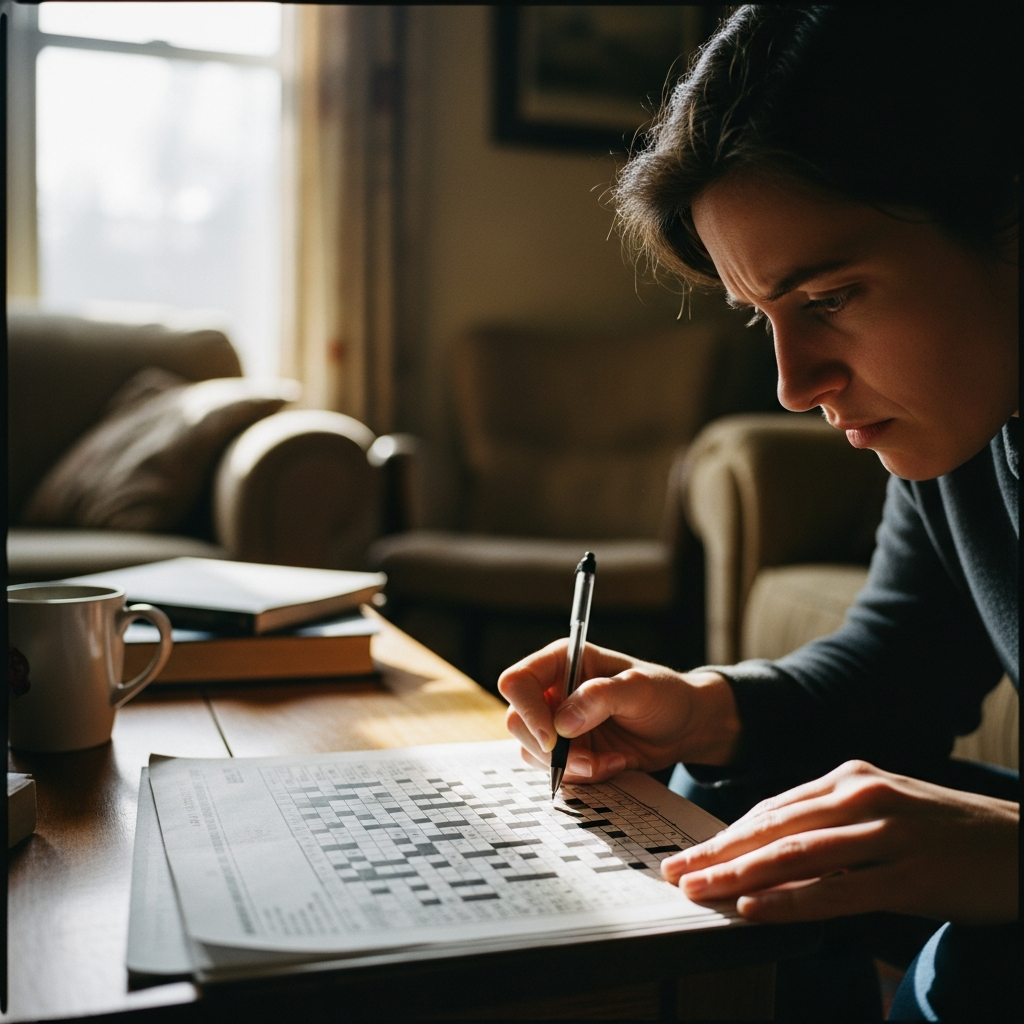
Let us be brutally honest for a moment: your morning Wordle routine has lost its edge. What began as a pandemic-era cultural phenomenon has slowly devolved into a mindless, two-minute chore. You type in “CRANE,” you chase the yellow and green squares, and you close the tab. The dopamine hit is fleeting. The intellectual stimulation? Practically nonexistent. If you are craving a puzzle that actually demands lateral thinking, wit, and genuine analytical rigor, the era of the five-letter guessing game is over. It is time to graduate to the cryptic crossword.
For the uninitiated, a cryptic crossword grid looks exactly like a standard newspaper puzzle, but the clues read like the paranoid ramblings of a madman. They seem entirely devoid of logic. However, beneath that opaque surface lies a highly structured, fiercely elegant game of linguistic chess. Cryptics do not test your knowledge of obscure trivia; they test your ability to deconstruct language. Once you understand the underlying mechanics, cracking a cryptic clue delivers a deeply satisfying rush that Wordle could never hope to match.
The barrier to entry is notoriously high, but it is far from impenetrable. You simply need the cipher. Here is the definitive *Plumeo* guide to decoding the daily cryptic puzzle.
The Golden Rule: The Anatomy of a Cryptic Clue
To solve a cryptic, you must abandon everything you know about traditional crosswords. In a standard puzzle, a clue like “Canine companion (3)” simply points to DOG. In a cryptic puzzle, the clue is actually two clues masterfully disguised as a single sentence.
Every well-written cryptic clue consists of two distinct parts: a straight, literal definition of the answer, and a set of wordplay instructions on how to build that answer. The straight definition will always sit at the very beginning or the very end of the clue—never in the middle. Your first and most crucial task is to find the seam. You must figure out where the literal definition ends and the linguistic sleight of hand begins.
How to Crack the Code: 4 Essential Cryptic Strategies
Cryptic setters use a specific arsenal of tricks to hide their answers. Once you learn to spot the “indicator words” that signal which trick is being deployed, the gibberish suddenly transforms into a clear set of instructions. Here are the four foundational mechanics you need to master.
1. The Anagram
Anagrams are the bread and butter of the cryptic crossword. The setter will give you a word (or words) to scramble, alongside an “indicator” word that implies chaos, movement, or destruction. Look for words like bad, broken, crazy, drunk, confused, or wild.
Example: Bad credit is direct (6)
Break it down. “Bad” is your indicator. It tells you to scramble the word immediately following it: “credit.” If you rearrange the six letters of CREDIT, you get DIRECT. The word “direct” also serves as the straight definition at the end of the clue. The seam is right between “is” and “direct.”
2. The Hidden Word
Sometimes, the answer is staring you right in the face, completely intact, but buried within the letters of the clue itself. The setter will use indicator words that suggest containment, such as inside, hiding, part of, or some.
Example: Some blame a ruffian for the animal (4)
The indicator here is “some,” signaling that the answer is literally hidden inside the subsequent words. Look closely at the phrase “blaME A Ruffian.” Tucked seamlessly across those words is the word BEAR, which perfectly matches the straight definition at the end of the clue: “the animal.”
3. The Reversal
This trick requires you to read a word backwards to find the answer. Reversal indicators are highly spatial. In an across clue, look for words like back, returning, or west. In a down clue, look for up, rising, or over.
Example: Returned desserts are stressed (8)
The word “returned” is the indicator. It instructs you to take the word “desserts” and spell it backwards. Doing so yields STRESSED, which matches the literal definition at the end of the sentence.
4. The Double Definition
Occasionally, a cryptic clue abandons wordplay entirely and instead offers two completely different literal definitions for the exact same word, mashed together to sound like a cohesive phrase.
Example: A heavy weight to clean (4)
There is no anagram or hidden word here. Instead, the clue is split perfectly in half. “A heavy weight” is a WASH (as in the backwash or wake of a ship, or a heavy load), and “to clean” is also to WASH. The answer is WASH.
Where to Begin Your Cryptic Journey
Do not attempt to tackle the Sunday Times cryptic on your first day; you will only end up frustrated. Start with puzzles explicitly designed to ease beginners into the format. The Guardian’s Quiptic puzzle is legendary for this exact purpose—it utilizes standard cryptic rules but applies them with a lighter, more forgiving touch. Additionally, apps like Cryptic Crosswords or the New York Times variety puzzle section offer excellent entry-level grids.
Mastering the cryptic crossword is not an overnight endeavor. It requires patience, a willingness to be misled, and an appreciation for the elasticity of the English language. But the moment you independently dissect a clue, spot the hidden indicator, and write in the correct answer, you will understand the obsession. You will never look at a five-letter grid the same way again.
Original Reporting: lifehacker.com