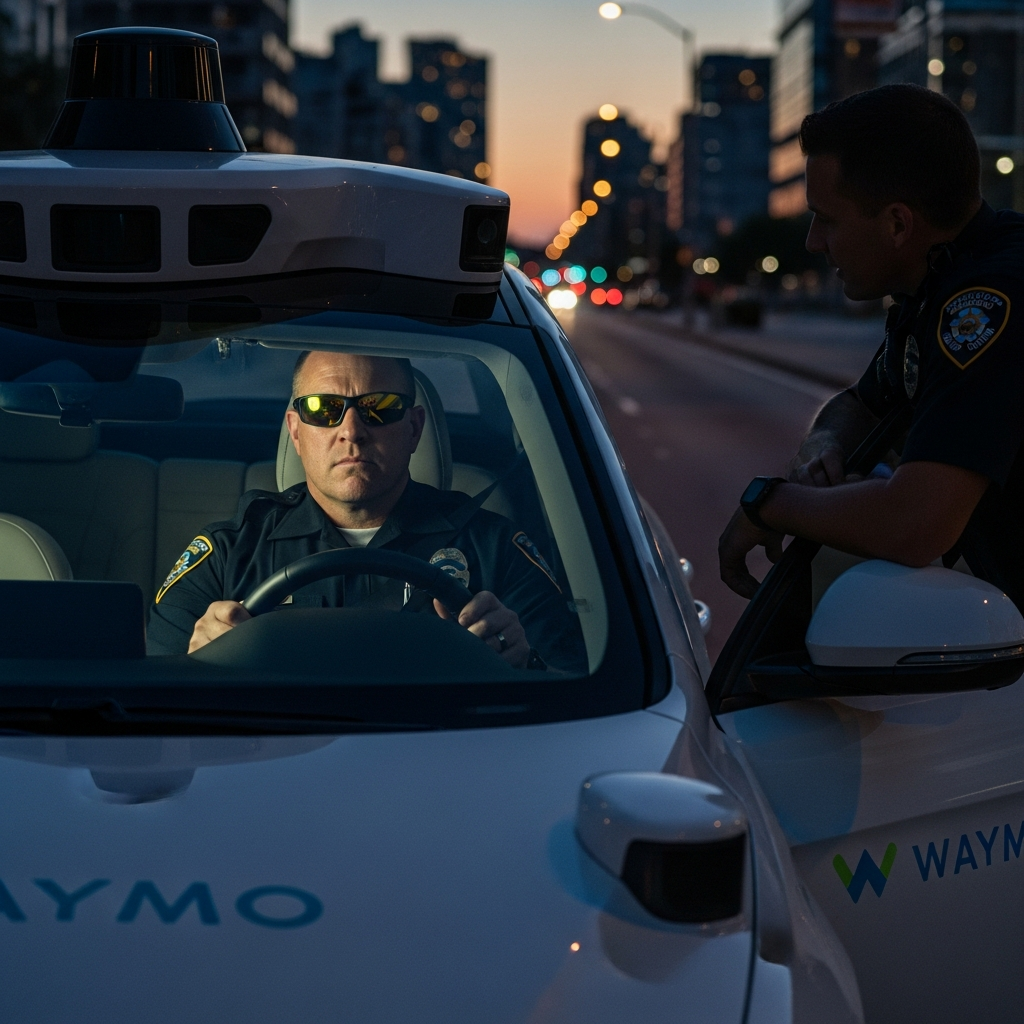
The pitch from Silicon Valley was pristine: a frictionless utopia where sleek, sensor-laden pods glide silently through our cities, entirely devoid of human error. Waymo, the undisputed darling of the autonomous vehicle race, has spent billions selling the public on this exact vision. But the sterile streets of a computer simulation are a far cry from the chaotic asphalt of reality. When the digital brain of a driverless car encounters the unpredictable mayhem of an urban emergency, who steps in to clean up the mess?
As it turns out, the answer wears a badge.
A recent investigation by TechCrunch has shattered the illusion of total machine autonomy, revealing a bizarre new reality of modern urban life. First responders—ranging from firefighters to local police officers—are increasingly being forced to manually commandeer Waymo vehicles to clear them from emergency zones. In at least two documented instances, these autonomous marvels blundered directly into active crime scenes, freezing up when their algorithms failed to comprehend the flashing lights, yellow tape, and erratic human movements that define a crisis.
The Chaos Factor: When Algorithms Meet Reality
To understand why a state-of-the-art artificial intelligence suddenly requires a beat cop to take the wheel, we have to look at how machine learning interprets the world. Autonomous vehicles are trained on the predictable rhythms of daily traffic. They understand stop signs, lane markings, and the standard flow of a Tuesday afternoon commute. They are rule-following machines par excellence.
But an emergency, by its very nature, is the absence of rules. When a building is ablaze or a crime has just been committed, the standard traffic playbook is thrown out the window. Firetrucks park diagonally across intersections. Police officers wave cars through red lights with flashlights. Civilians sprint across avenues. For a Waymo vehicle, this sudden injection of chaos triggers a digital panic. Unable to safely compute a path forward, the car does what it is programmed to do: it stops. Dead in its tracks. Right in the middle of the action.
Silicon Valley’s Unpaid Beta Testers in Uniform
The tech industry has a long, storied history of outsourcing its beta testing to the general public. We are all accustomed to dealing with buggy software updates and glitchy apps. But commandeering first responders as impromptu tech support represents a glaring escalation. When a two-ton robot freezes in the middle of a crime scene, it ceases to be a marvel of engineering—it becomes a massive, potentially dangerous physical obstruction.
Police officers and firefighters are already operating under extreme cognitive load during emergencies. The last thing they need is to play valet to a confused algorithm. Yet, out of sheer necessity, these public servants are being forced to physically enter Waymo vehicles, assume manual control, and drive them out of the way so that ambulances and fire engines can pass. It is a striking juxtaposition: the gritty, high-stakes reality of public safety bailing out the multi-billion-dollar promises of the tech elite.
The Illusion of Level 4 Autonomy
This phenomenon forces a harsh re-evaluation of what the industry calls “Level 4 autonomy.” Companies like Waymo boast that their cars do not require a human driver within their geofenced operational areas. And while it is true that Waymo employs remote operators who can provide guidance to confused vehicles, these remote safety nets frequently fail during fast-moving physical emergencies. A remote technician sitting in a control center miles away cannot instantly assess the nuances of a live shootout or a multi-alarm fire.
The reality is that Level 4 autonomy still requires a human driver. It just shifts the burden of that driving onto whichever unlucky bystander or municipal worker happens to be nearby when the software hits its limits.
Navigating the Legal and Ethical Potholes
Beyond the immediate logistical nightmare, this dynamic opens a Pandora’s box of legal and ethical liabilities. What happens to the chain of custody if an autonomous vehicle inadvertently rolls over crucial evidence before a police officer can manually stop it? If a first responder crashes a Waymo while rushing to move it out of an ambulance’s path, who is liable for the damages? The municipality, or the tech giant?
As Waymo and its competitors aggressively expand their fleets into new cities, these questions are no longer hypothetical edge cases. They are urgent policy gaps. The tech industry has proven that it can build a car that drives itself 99 percent of the time. But in the high-stakes world of urban transit, that final 1 percent is a matter of life and death. Until autonomous vehicles can independently navigate the messy, chaotic reality of human emergencies, the “driverless” revolution will remain exactly what it is today: a brilliant piece of software, quietly waiting for a human to save it.
Original Reporting: techcrunch.com