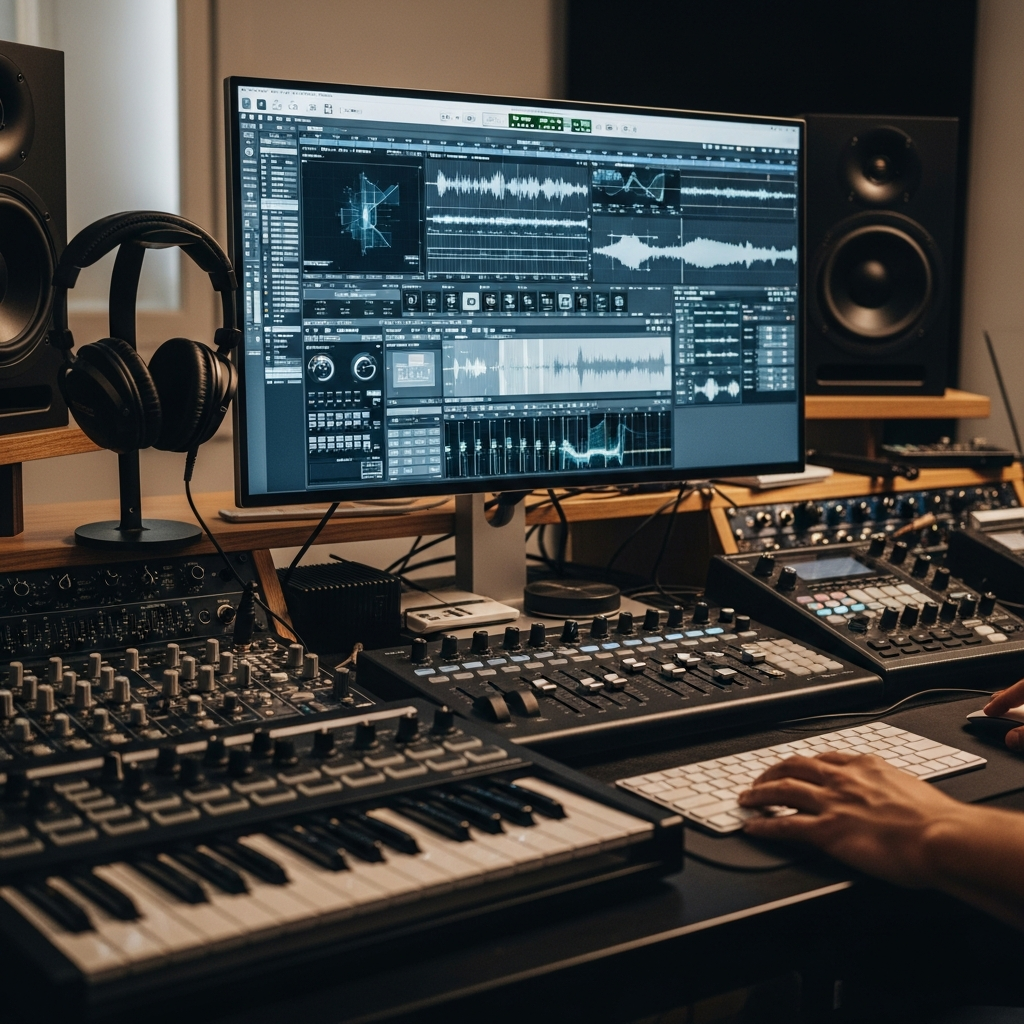
The pervasive anxiety that artificial intelligence would render the human music producer obsolete has officially dissipated. As we navigate 2026, the global music industry has arrived at a more pragmatic, lucrative consensus: AI is not a replacement for human taste; it is the ultimate lever for it.
For the modern producer, the studio is no longer just a physical space filled with analog hardware and digital audio workstations (DAWs). It is a hybrid ecosystem powered by machine learning infrastructure. The producers dominating the Billboard charts and commanding premium sync licensing fees are those who have successfully integrated AI into their day-to-day operations—stripping away technical friction to optimize their most valuable asset: creative intuition.
As the Lead Tech Editor at Plumeo, I have analyzed the software suites utilized by top-tier hitmakers, scoring composers, and independent auteurs. This definitive, evergreen guide breaks down the essential AI tools for music producers in 2026, categorized by their distinct roles in the modern production pipeline.
Category 1: AI-Driven Audio Creation & Synthesis
The days of relying solely on static sample packs and traditional oscillators are behind us. The new frontier of sound design leverages neural networks to generate entirely bespoke audio, offering unprecedented control over timbre, pitch, and texture.
Generative MIDI and Melodic Ideation
Blank canvas syndrome is a liability in a high-output industry. Today’s generative MIDI tools act as elite co-writers. By analyzing decades of hit records across specific genres, these algorithms can instantly generate complex chord progressions, counter-melodies, and polyrhythmic drum patterns. The standout platforms in 2026 do not dictate the song’s direction; rather, they offer highly customizable parameters—allowing producers to dial in the exact degree of syncopation, harmonic tension, and humanized “swing” before printing the MIDI to their DAW for further manipulation.
Timbre Transfer and Neural Synthesis
Perhaps the most significant leap in audio creation is the maturation of timbre transfer. Using advanced neural synthesis, producers can now record a melody using their own voice and seamlessly map those exact phrasing nuances onto a meticulously sampled Stradivarius violin or a vintage Moog synthesizer. This technology bypasses the limitations of traditional MIDI controllers, allowing the raw emotion and micro-timing of a human vocal performance to articulate complex virtual instruments. Furthermore, ethical, artist-licensed voice cloning models have created a lucrative secondary market, allowing producers to lease the vocal timbres of established artists for demo pitching or commercial releases.
Category 2: Intelligent Mixing, Mastering, and Restoration
Audio engineering has historically required decades of ear training. While a seasoned mix engineer remains invaluable for a platinum release, AI has democratized high-fidelity sonics, ensuring that even early-stage demos meet commercial loudness and clarity standards.
Contextual Equalization and Dynamic Resonance Suppression
Standard EQs and compressors are reactive; AI-driven mixing processors are predictive and contextual. The premier mixing suites of 2026 utilize machine learning algorithms that “listen” to the entirety of a multitrack session. They instantly identify frequency masking between a kick drum and a sub-bass, or harsh sibilance in a vocal track, and apply dynamic, real-time suppression. These tools analyze the spatial field and frequency spectrum, offering producers a mathematically balanced starting point that they can then color with creative, analog-emulated saturation.
Stem Separation and Spatial Audio Upmixing
The demand for Dolby Atmos and spatial audio formats has skyrocketed. AI-powered stem separation—once a muddy, artifact-heavy novelty—is now flawlessly precise. Producers can extract crystalline acapellas or isolated drum breaks from decades-old stereo masters with zero phase cancellation. More importantly, algorithmic upmixing tools can now intelligently distribute stereo stems into a 7.1.4 immersive audio environment, automating the tedious panning and spatial routing required for modern streaming platform compliance.
Category 3: Workflow Automation & Studio Management
The unglamorous reality of music production is that a significant portion of a producer’s time is spent on administrative tasks: organizing files, searching for sounds, and routing signals. AI has effectively eliminated this operational bloat.
Semantic Sample Curation
A massive sample library is useless if you cannot find the right snare drum in under ten seconds. Modern AI file management systems utilize semantic audio search to organize terabytes of unlabelled wav files. Instead of relying on manual text tags, the AI analyzes the acoustic properties of the audio itself. Producers can simply prompt their library with requests like, “Find me a dry, acoustic snare drum with a fundamental frequency of 200Hz and a short decay,” and the algorithm will instantly curate a bespoke folder of options.
Session Organization and Gain Staging
Time is the only non-renewable resource in the studio. AI plugins now exist solely to automate session housekeeping. With a single click, these tools can auto-color-code tracks by instrument family, automatically route stems to the appropriate sub-buses, and mathematically gain-stage an entire 150-track session to hit a perfect -18dBFS headroom target. This ensures the producer remains in a flow state, rather than acting as an IT technician.
Category 4: Audience Analytics & Predictive A&R
In 2026, the role of the producer frequently overlaps with that of the A&R executive and the marketer. Releasing music into the digital ether without data is a gamble; AI provides the strategic blueprint.
Algorithmic Trend Forecasting
By scraping billions of data points across global streaming platforms, short-form video networks, and underground DJ sets, AI analytics platforms can identify emerging sonic trends before they reach the mainstream. Producers can view real-time heat maps indicating spikes in specific tempos, instrumentation (e.g., a resurgence of 90s breakbeats in European markets), and lyrical themes. This data allows commercial producers to tailor their output to impending market demands, maximizing sync opportunities and playlist placements.
Pre-Release Performance Scoring
Before a master file is ever uploaded to a distributor, predictive AI models can analyze the audio file and provide a commercial viability score. By comparing the track’s dynamic range, harmonic structure, and hook placement against the current Top 100, these tools offer actionable feedback. While no algorithm can account for the unpredictable magic of cultural zeitgeist, these insights provide a crucial baseline for commercial viability, helping producers decide which tracks warrant a massive marketing budget.
The Economics and Ethics of the Algorithmic Studio
As we fully integrate these systems, the premium value in music production is shifting. When technical perfection becomes automated and ubiquitous, flawless execution is no longer a competitive advantage—it is merely the baseline.
The true economic differentiator in 2026 is the “Human Premium.” AI can perfectly EQ a vocal, but it cannot decide *why* a vocal should sound intentionally distorted to convey heartbreak. It can generate a flawless chord progression, but it cannot draw from lived experience to write a lyric that resonates with a generation. The tools outlined in this guide are formidable, but they require a visionary architect to direct them. For the modern producer, AI is the ultimate workforce; human taste remains the CEO.