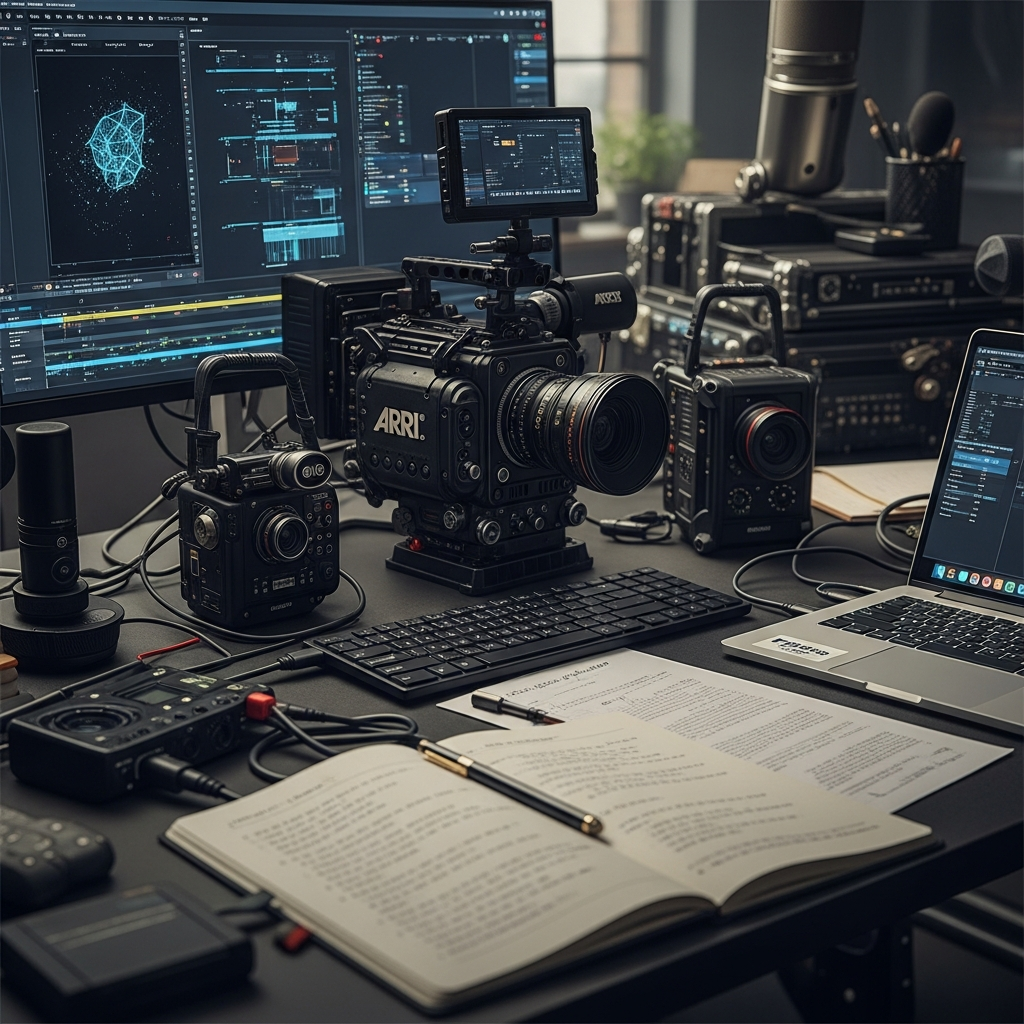
Independent cinema has historically been defined by a distinct friction between creative ambition and available capital. Directors and producers were forced to compromise on scale, relying on practical workarounds to mask budgetary limitations. In 2026, that friction has largely dissolved. Artificial intelligence has transitioned from a polarizing novelty into foundational production infrastructure, allowing lean production companies to execute studio-scale visions on microscopic budgets.
For the modern auteur, understanding this technology is no longer optional; it is a prerequisite for market viability. As the Lead Tech Editor for Plumeo, I have spent the past year analyzing the software ecosystems driving the most profitable independent films at Sundance, Cannes, and SXSW. This guide deconstructs the definitive AI stack for modern filmmakers, categorized by the core phases of production.
Pre-Production & Workflow Automation
The highest immediate return on investment for AI integration lies in logistics. Pre-production is traditionally a capital-intensive phase requiring weeks of manual labor. Today’s machine learning models compress this timeline, allowing producers to allocate funds directly to the screen rather than administrative overhead.
Script Analysis & Breakdown
The days of producers manually highlighting scripts with colored markers to generate shot lists and prop inventories are over. Platforms like **Largo.ai** and the 2026 iteration of **Celtx Neural** utilize advanced natural language processing to ingest a 120-page PDF and output a comprehensive production breakdown in seconds. These systems identify required cast, locations, specialized props, and VFX shots, immediately cross-referencing this data against regional union rates and equipment rental costs to generate highly accurate preliminary budgets.
Storyboarding & Pre-visualization
Visualizing a film before principal photography is critical for securing investor capital. Tools like **Midjourney v8** and **Cinematic AI** have evolved past simple image generation into cohesive pre-visualization suites. Directors can train these models on specific aspect ratios, lens focal lengths (e.g., 35mm anamorphic), and lighting setups. By feeding character reference photos into the system, filmmakers can generate sequential, photorealistic animatics with consistent character models, effectively creating a zero-budget proof of concept that looks indistinguishable from a finished film still.
Production & Visual Creation
On set, time is the ultimate currency. Artificial intelligence now serves as a digital second unit, mitigating the risks of principal photography and expanding the visual scope of independent projects without requiring additional crew.
Generative B-Roll & Asset Creation
Perhaps the most significant shift in the 2026 landscape is the maturation of text-to-video generation. Platforms like **OpenAI’s Sora Pro** and **Runway Gen-4** can now output temporally consistent, 4K 60fps footage that holds up to theatrical projection standards. For indie filmmakers, this eliminates the need for expensive second-unit shoots or generic stock footage. Whether a script requires an establishing drone shot of a neon-lit Tokyo street or a macro shot of a blooming flower, directors can generate bespoke, highly specific assets on demand, retaining complete creative control over lighting and camera movement.
Real-Time Audio & Dialogue Processing
Poor audio has historically been the immediate tell of an amateur production. The 2026 audio stack entirely removes environmental limitations. **Adobe Podcast AI** and **ElevenLabs** have developed sophisticated neural networks capable of isolating vocal frequencies from catastrophic background noise. Furthermore, automated dialogue replacement (ADR) has been radically streamlined. Instead of renting a recording booth to fix a flubbed line, directors can use voice-cloning algorithms trained on their actor’s vocal profile to type the corrected dialogue, generating a seamless, emotionally accurate audio replacement that perfectly matches the on-set acoustics.
Post-Production & Editing
Post-production is the traditional bottleneck of independent cinema, where projects often languish for months due to the sheer volume of manual labor required. AI has restructured the editing bay, transforming the editor from a technician into a pure storyteller.
Automated Assembly & Color Grading
**DaVinci Resolve’s Neural Engine** has reached a point of near-autonomy for basic assembly. Using text-based editing capabilities, the software can analyze transcripts, remove dead space, and assemble a rough cut based on the script’s dialogue flow. For color grading, AI models can now analyze a reference frame from a blockbuster film and instantly map its exact colorimetry and contrast ratios onto flat, log-profile indie footage. This ensures visual continuity across different camera sensors, allowing a B-camera DSLR to seamlessly match an A-camera ARRI Alexa.
VFX & Rotoscoping
Visual effects are no longer the exclusive domain of Marvel or Industrial Light & Magic. Tools like **Wonder Dynamics** allow single users to drag and drop CG characters into live-action scenes. The AI automatically handles lighting, tracking, and composition, effectively eliminating the need for green screens or motion-capture suits. Similarly, AI rotoscoping tools can isolate complex subjects—like hair blowing in the wind—with absolute precision. By reducing a two-week masking sprint into a four-hour compute task, post-production houses can drastically lower their billing hours.
Distribution & Audience Analytics
A finished film holds no value if it fails to find its audience. The final hurdle for the independent filmmaker is distribution, an arena historically controlled by opaque studio algorithms and high-priced marketing agencies.
Predictive Success & Marketing
Before a film even hits the festival circuit, platforms like **Cinelytic** offer predictive analytics that forecast a project’s financial performance based on genre, cast, and narrative structure. In 2026, these tools are accessible to the indie tier, allowing producers to identify the exact demographic most likely to purchase a VOD stream. Furthermore, AI marketing suites can ingest a two-hour feature and automatically cut dozens of A/B tested trailers, perfectly optimized for the specific aspect ratios and attention-retention algorithms of TikTok, Instagram, and YouTube.
The Future of the Auteur
The proliferation of artificial intelligence in cinema does not devalue the human element; rather, it amplifies it. When the technical barriers to entry are removed, the only remaining differentiator is taste. The definitive indie filmmakers of 2026 are those who view AI not as a replacement for human ingenuity, but as an infinitely scalable crew. By mastering this technology stack, independent directors can finally execute their most uncompromising visions, operating with the financial agility of an indie and the cinematic authority of a major studio.