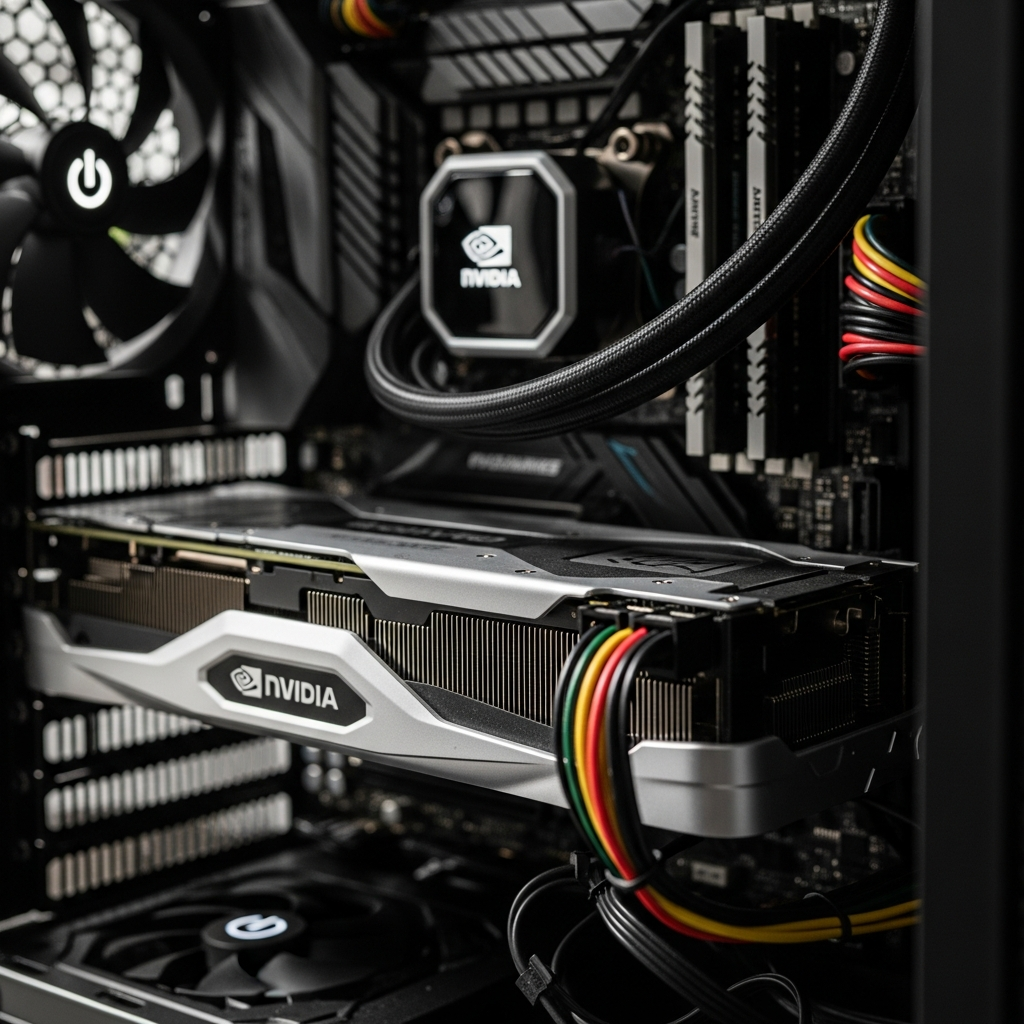
Picture the scene: You have just assembled a masterpiece of modern computing. Your rig boasts a flagship GPU, a top-tier processor, and enough RAM to model a small galaxy. You boot up the year’s most anticipated AAA blockbuster, ready to be immersed in ray-traced glory, only to be greeted by a crawling, archaic progress bar: “Compiling Shaders: 12%.”
For the past three years, this has been the dark, unspoken reality of high-end PC gaming. Despite the exponential leaps in raw silicon horsepower, the user experience has been routinely hijacked by agonizing wait times and game-breaking stutters. But the era of staring blankly at a loading screen is finally drawing to a close. Nvidia has officially rolled out a sweeping driver-level fix to mitigate the shader compilation crisis, signaling a massive shift in how the industry handles rendering bottlenecks.
The Anatomy of a Digital Epidemic
To understand the brilliance of Nvidia’s intervention, we first have to dissect the disease. The “compiling shaders” epidemic was born out of a fundamental shift in how games communicate with hardware. With the transition to low-overhead APIs like DirectX 12 and Vulkan, the responsibility of managing shaders—the micro-programs that dictate how light, shadows, and materials look on your screen—shifted from the graphics driver directly to the game developers.
In theory, this gave studios unprecedented control. In practice, it created a fragmented nightmare. If a game attempted to compile these shaders on the fly while you were playing, the result was the notorious “traversal stutter”—a jarring freeze right as you turned a corner or entered a new environment. To prevent this, developers began forcing games to pre-compile every single shader before the main menu even loaded. It was a brute-force solution that turned launching a game into a grueling test of patience, often taking upwards of twenty minutes on massive titles.
High-end consumers were rightfully furious. Premium hardware should guarantee a frictionless experience, not a mandatory waiting room. Nvidia recognized that relying solely on fragmented game studios to optimize their code was a losing battle. The green team needed to fix this at the foundation.
Nvidia’s Silver Bullet
Nvidia’s approach is a masterclass in software engineering rescuing hardware limitations. Rather than waiting for developers to patch individual titles, Nvidia has fundamentally overhauled how its drivers handle shader caching. By intelligently expanding the cache size limits and streamlining the pipeline that processes these micro-programs, Nvidia’s latest drivers allow your system to store and retrieve compiled shaders with unprecedented efficiency.
This means that the initial compilation process is drastically accelerated, and in many cases, entirely bypassed upon subsequent launches. The GPU behemoth is leveraging its deep driver-level access to mask the inefficiencies of modern game engines. For the end user, the result is instantaneous: games boot faster, menus are accessible almost immediately, and the in-game traversal stutter is violently minimized.
It is a testament to Nvidia’s understanding of the modern luxury tech space. Raw teraflops are meaningless if the software delivery mechanism is broken. By stepping in to clean up the DirectX 12 mess, Nvidia is protecting the premium aura of its RTX lineup.
The Silicon Arms Race: Intel and Microsoft Enter the Fray
Nvidia, however, is not operating in a vacuum. The shader compilation disaster has become such a universally recognized pain point that the rest of the tech trinity is mobilizing to eradicate it. This isn’t just a graphics card issue; it is a systemic flaw in the PC gaming ecosystem.
Microsoft, the architect behind the DirectX API that inadvertently fueled this fire, is currently developing native, OS-level solutions. By refining the DirectX Agility SDK, Microsoft aims to standardize how developers handle shader pipelines, pushing for asynchronous compilation that doesn’t hold the player hostage. Meanwhile, Intel is aggressively optimizing its Arc graphics division to tackle the exact same bottleneck, proving that the newcomer to the discrete GPU market understands exactly what modern gamers value.
When the creator of the operating system, the dominant GPU manufacturer, and the largest CPU maker in the world all align their crosshairs on a single software issue, that issue’s days are numbered.
The Dawn of Frictionless Play
What we are witnessing is the maturation of the PC gaming platform. For decades, the industry was locked in a pure hardware arms race—pushing higher clock speeds, more cores, and denser transistors. But as we reach the upper echelons of visual fidelity, the battleground has shifted. The new gold standard isn’t just performance; it is seamlessness.
Nvidia’s fix for the shader compilation wait times is more than just a patch note buried in a driver update. It is a declaration that the premium PC experience should be exactly that: premium. As Microsoft and Intel prepare to deploy their own reinforcements, the message to consumers is clear. The days of the stuttering, stalling, and waiting are over. The future of high-end gaming is finally ready to play.
Original Reporting: arstechnica.com