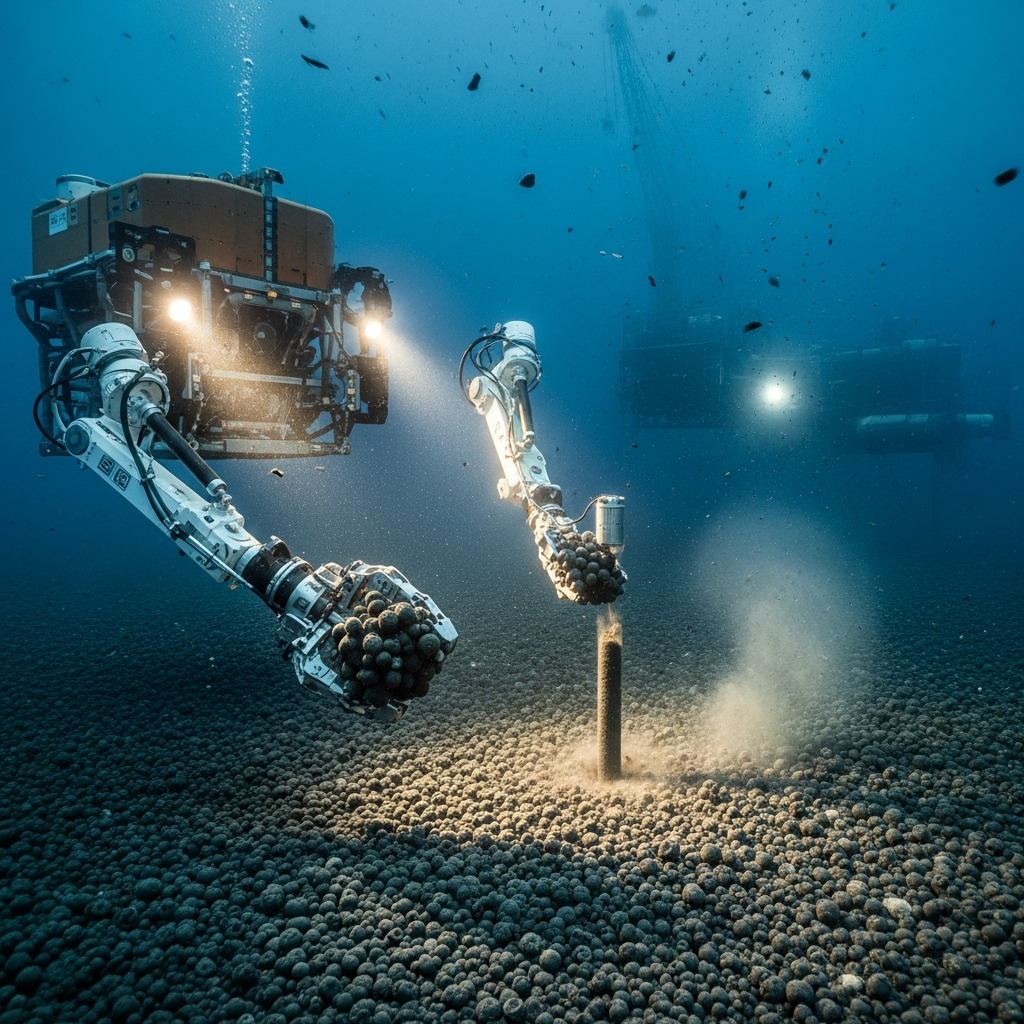
Three miles beneath the surface of the Pacific Ocean, in a realm devoid of sunlight and crushed by immense hydrostatic pressure, lies the ultimate geopolitical prize of the 21st century. Scattered across the abyssal plain are trillions of polymetallic nodules—potato-sized lumps of rock practically humming with cobalt, nickel, copper, and manganese. For an electric vehicle and renewable energy sector desperate to sever its reliance on fraught terrestrial supply chains, these depths look less like a fragile ecosystem and more like a limitless battery vault.
But a fierce debate is currently paralyzing international policymakers, marine biologists, and tech executives alike. The question is no longer just whether we have the robotic prowess to vacuum up the seafloor. The real question is far more existential: Do we actually need these metals to achieve our green transition, and can we extract them without triggering an ecological catastrophe?
The Lure of the ‘Battery in a Rock’
To understand the sudden gold rush in the deep ocean, you have to look at the math driving the tech industry. The transition from internal combustion engines to electric vehicles (EVs), coupled with the massive grid storage required for solar and wind energy, demands an astronomical volume of raw materials. Terrestrial mining is struggling to keep pace, plagued by declining ore grades, devastating deforestation, and grave human rights abuses in places like the Democratic Republic of Congo.
Enter deep-sea mining startups, who pitch a seductive narrative to Silicon Valley. They argue that scraping the Clarion-Clipperton Zone—a vast stretch of ocean floor between Hawaii and Mexico—is a necessary evil. Why hollow out a rainforest, they ask, when you can deploy autonomous underwater vehicles to quietly harvest nodules from a seemingly barren, alien landscape? It sounds like a neat, technology-driven solution to a messy, terrestrial problem.
Engineering the Deep—and the Fallout
The engineering required to mine the abyss is nothing short of miraculous. We are talking about deploying SUV-sized, remote-controlled crawler robots that must operate flawlessly at freezing temperatures under pressures that would crush a nuclear submarine. These machines are designed to traverse the soft sediment, suck up the nodules, and pump them through miles of riser pipes to motherships waiting on the surface.
Yet, the technological marvel of this extraction masks a brutal ecological reality. The deep ocean is not a barren wasteland; it is one of the oldest, most stable, and least understood biomes on Earth. It is teeming with endemic life forms—ghostly octopuses, ancient corals, and bioluminescent organisms that have evolved over millennia in perfect isolation.
Marine scientists warn that deep-sea mining will unleash apocalyptic sediment plumes that could suffocate marine life for hundreds of miles. The deafening acoustic pollution from the crawlers and pumps threatens to disorient cetaceans and disrupt the delicate communication networks of deep-pelagic species. Once the ocean floor is strip-mined, the damage is effectively permanent. In the deep sea, where biological processes move at a glacial pace, recovery is measured not in decades, but in millennia.
The Billion-Dollar Pivot: Do We Even Need It?
This brings us to the crux of the policy debate, and the sharpest counter-argument to the deep-sea mining lobby: the tech industry might be innovating too fast for these minerals to even matter.
The assumption that we must harvest the ocean floor relies on a static view of battery chemistry. But battery technology is anything but static. Major EV manufacturers are already aggressively pivoting away from the very metals found in polymetallic nodules. Lithium Iron Phosphate (LFP) batteries, which require zero nickel and zero cobalt, now dominate the global EV market. Meanwhile, breakthroughs in sodium-ion technology—utilizing one of the most abundant elements on Earth—are poised to revolutionize grid-scale energy storage.
Furthermore, the circular economy is finally coming online. Advanced recycling startups are utilizing artificial intelligence and novel hydrometallurgical processes to recover up to 95% of the critical metals from spent batteries. By the time deep-sea mining operations reach commercial scale and profitability, the tech world may have already engineered its way out of the bottleneck.
A Regulatory Wild West
Despite the rapid evolution of alternative battery chemistries, the regulatory machinery is plowing forward. The International Seabed Authority (ISA), a relatively obscure UN-affiliated body based in Jamaica, is under immense pressure to finalize the mining code that will govern the exploitation of international waters. Geopolitics is accelerating the timeline; Western nations are terrified of ceding control of future supply chains to geopolitical rivals, prompting a rush to claim underwater territories before the environmental science is fully settled.
Policymakers are standing at the precipice of a generational mistake. Approving deep-sea mining under the guise of ecological necessity is a paradox of the highest order. We cannot destroy the largest carbon sink and most pristine ecosystem on the planet in a misguided attempt to save the climate.
The tech industry prides itself on disruption and elegant problem-solving. Plundering the abyss is neither. It is a brute-force relic of an extractive mindset that we are desperately trying to leave behind. True innovation lies in material science, synthetic chemistry, and closed-loop recycling—not in sending giant vacuums to the bottom of the ocean to repeat the sins of the fossil fuel era.
Original Reporting: arstechnica.com