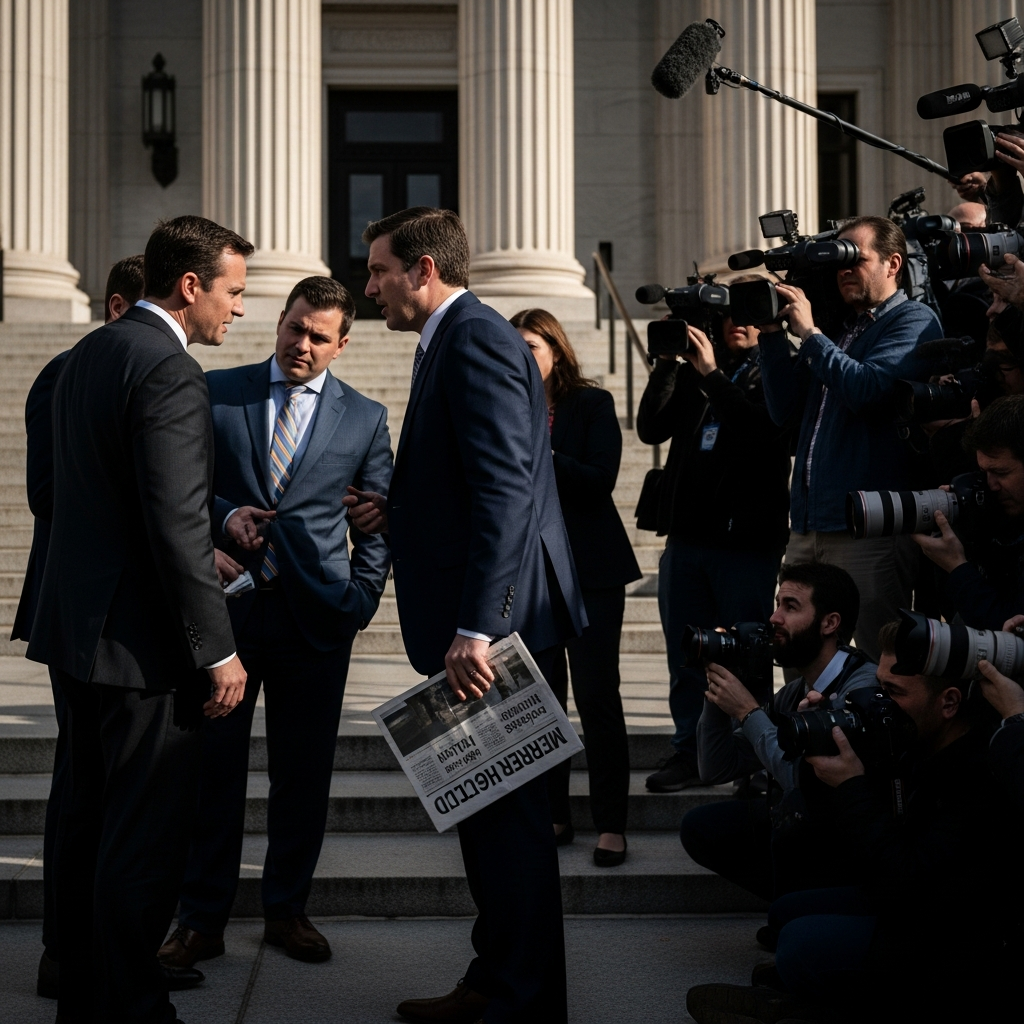
The era of unchecked media consolidation just slammed into a judicial brick wall. In a stunning reversal that has left broadcast executives and digital media strategists reeling, a federal judge has officially halted the behemoth merger between Nexstar Media Group and Tegna. The mandate was delivered with zero ambiguity: “Defendants must immediately cease” all actions to integrate and consolidate the two firms.
For years, the tech and media sectors have operated under a prevailing assumption that regulatory bodies would eventually green-light any mega-merger, provided the corporate lobbyists were persistent enough. But this abrupt injunction rewrites the playbook. By stepping in where the Federal Communications Commission (FCC) effectively stepped aside, the courts have signaled a fierce new dawn for antitrust enforcement in the digital broadcasting space.
The FCC’s Blind Eye Meets the Gavel
To understand the gravity of this ruling, we have to look at the regulatory gymnastics that brought us here. The FCC enforces a strict national TV ownership limit, capping a single corporation’s reach at 39% of U.S. television households. It is a necessary safeguard designed to prevent monopolistic control over local news, digital advertising ecosystems, and localized tech infrastructure.
Yet, through a labyrinthine series of loopholes and regulatory leniencies, the FCC initially allowed the Nexstar-Tegna Voltron to exceed this very limit. Nexstar, already the largest local television and media company in the United States, was poised to absorb Tegna’s massive portfolio, creating an unprecedented monolith. The merger would have granted a single entity disproportionate control over the digital airwaves, programmatic ad-tech networks, and Over-The-Top (OTT) streaming platforms across the country.
The judicial intervention calls out the quiet complicity of regulatory bodies that allow legacy rules to be bypassed through corporate shell games. By ordering an immediate halt to the integration, the court isn’t just pausing a financial transaction; it is actively dismantling a dangerous precedent in media technology.
Why Media Tech Consolidation is a Dangerous Game
From a technology standpoint, the Nexstar-Tegna merger is far more than a reshuffling of broadcast towers and anchor desks. It is a battle for the underlying digital infrastructure that powers how millions of Americans consume information.
When media giants consolidate, the first casualty is usually technological innovation. A combined Nexstar-Tegna would wield immense leverage over digital distribution networks, forcing smaller tech vendors, app developers, and independent content platforms out of the market. Furthermore, local news platforms—which have increasingly relied on agile, localized Content Management Systems (CMS) and bespoke streaming apps to reach cord-cutters—often see their tech stacks homogenized post-merger.
Instead of investing in next-generation broadcast tech like ATSC 3.0 (which promises 4K resolution, interactive content, and targeted digital advertising over the air), monopolistic giants tend to slash R&D budgets to pay down acquisition debt. By halting this merger, the court has inadvertently preserved a competitive ecosystem where regional broadcasters must still innovate their digital offerings to win viewer attention.
The “Immediate Cease” Mandate: Unraveling the Tech Stack
The phrase “must immediately cease” is a logistical nightmare for any corporate IT and operations department. Merging two enterprise-level media companies involves months of shadow-integration. Cloud infrastructures are bridged, data lakes are merged, and programmatic advertising exchanges are synchronized.
Now, the digital architects at both Nexstar and Tegna are forced to hit the emergency brake. Halting an integration of this scale mid-flight means decoupling shared enterprise software, freezing CMS migrations, and untangling shared cybersecurity protocols. It is a chaotic, expensive unwinding that highlights the sheer hubris of executing structural integrations before the ink on the legal challenges has fully dried.
A Watershed Moment for Broadcast and Digital Media
This judicial smackdown reverberates far beyond the boardrooms of Nexstar and Tegna. It serves as a stark warning shot to other media-tech conglomerates—from streaming giants eyeing legacy studios to telecom providers looking to swallow up digital publishers. The assumption that the FCC will simply wave through acquisitions that violate the 39% cap is officially dead.
For the consumer, this is a distinct victory. A decentralized media landscape forces companies to compete on the quality of their digital platforms, the speed of their streaming apps, and the integrity of their local reporting. As the dust settles on this halted mega-merger, one thing is abundantly clear: the courts are finally waking up to the realities of modern media monopolies, and they are no longer afraid to drop the gavel.
Original Reporting: arstechnica.com