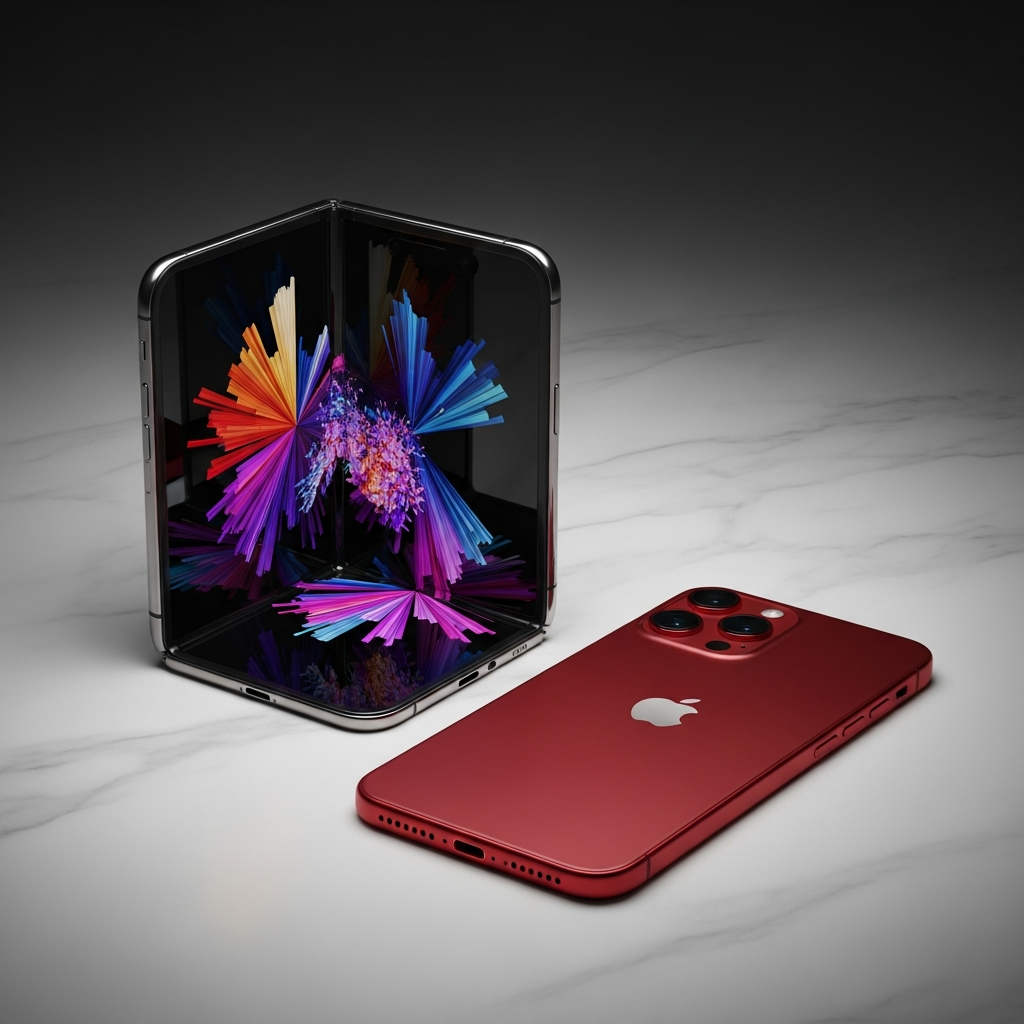
As we close out the first quarter of March 2026, the consumer technology sector is already looking past current fiscal earnings toward Cupertino’s traditional September keynote. With global smartphone upgrade cycles lengthening and market saturation reaching an all-time high, the stakes for Apple this autumn are uniquely elevated.
This year, the tech giant is reportedly preparing to bifurcate its ultra-premium lineup, forcing executives, power users, and early adopters into a fascinating financial and functional choice. On one side sits the iterative masterpiece, the iPhone 18 Pro. On the other, the long-rumored, highly scrutinized iPhone Fold.
The iPhone 18 Pro: The Zenith Of The Slab
For over a decade, the glass-and-titanium rectangle has been the undisputed king of mobile computing. The iPhone 18 Pro aims to perfect this established geometry rather than reinvent it.
The defining hardware feature of this year’s Pro model is a variable aperture main camera. By allowing the lens to mechanically adjust its opening, Apple is bringing true optical depth-of-field control and superior low-light performance to mobile photography. This engineering feat challenges dedicated DSLRs more aggressively than ever before, offering content creators and professionals unparalleled control over their imagery.
Underneath the glass, Apple is expected to debut the A20 chip, built on a groundbreaking 2-nanometer fabrication process. This silicon advantage translates to unprecedented thermal efficiency and raw processing power. The leap to 2nm ensures that heavy workloads, from on-device machine learning to high-resolution video rendering, are executed with minimal battery drain. For the pragmatic buyer, the 18 Pro represents the absolute ceiling of reliable, traditional smartphone engineering.
The iPhone Fold: A $2,000 Gamble
Then comes the disruptor. After years of watching competitors iterate on flexible OLED technology, Apple is finally ready to enter the foldable market. Leaks from the supply chain indicate the iPhone Fold will feature a seamless 7.6-inch inner screen, transforming the device from a standard pocketable handset into an iPad Mini substitute upon opening.
To power this dual-screen experience, Apple is equipping the Fold with a massive 12GB of RAM. This memory bump is strictly utilitarian, engineered to handle side-by-side multitasking, drag-and-drop capabilities, and complex onboard processing without a single stutter. But this distinct engineering marvel comes at a steep, unyielding price: an estimated $2,000 starting MSRP.
Form vs. Function: Justifying The Premium
Herein lies the multi-billion-dollar question for Apple’s September release: does a folding hinge and a larger canvas warrant a price tag nearly double that of a standard flagship?
For the past few years, the foldable market has been a high-priced niche, appealing mostly to enthusiasts willing to compromise on battery life and camera quality for screen real estate. Apple’s entry undoubtedly validates the form factor, but at $2,000, it demands rigorous justification from the consumer.
When placed side-by-side, the value proposition becomes a matter of professional workflow rather than raw benchmark superiority. The iPhone 18 Pro will undoubtedly offer a superior optical system. The variable aperture technology requires internal chassis space that a remarkably thin folding device simply cannot accommodate. Furthermore, early reports suggest the Fold’s internal architecture prioritizes the 12GB of RAM for multi-window memory management, leaving the absolute bleeding-edge processing speed to the 2nm A20-equipped 18 Pro.
Therefore, the $2,000 price tag is entirely an investment in the 7.6-inch display. For a specific subset of professionals—financiers reviewing complex spreadsheets on the tarmac, architects marking up blueprints on site, or executives who prefer to leave their tablets in the briefcase—that expansive inner screen offers tangible productivity returns. For these users, a phone is not just a communication device; it is a primary workstation.
The Verdict For September
Apple is not pricing the iPhone Fold to cannibalize or replace the iPhone 18 Pro. Instead, the company is creating a new “ultra-luxury” tier of mobile computing designed to push its Average Selling Price (ASP) even higher. It is a status symbol fused with an enterprise-grade productivity tool.
For the vast majority of premium buyers, the iPhone 18 Pro will remain the smarter acquisition. The introduction of the 2nm A20 chip and a variable aperture camera offer immediate, everyday benefits that easily justify a traditional flagship cost. However, for those who equate screen space with working capital, the iPhone Fold’s $2,000 barrier to entry will merely be the cost of doing business. This September, Apple will not just introduce two new devices; it will fiercely test the absolute elasticity of consumer pricing.