For decades, commercial fishing has operated on a draconian premise: drag a massive net across the ocean floor, scoop up everything in its path, and sort out the casualties later. It is an analog, brute-force solution in an increasingly digital world. The collateral damage of this method is known as “bycatch”—millions of tons of unintended marine life, from ancient sea turtles to endangered dolphins, swept up and suffocated in the pursuit of target species.
It is not just an ecological tragedy; it is a glaring operational inefficiency. But a new wave of precision ocean engineering is finally dragging the commercial maritime sector into the 21st century. By merging hydrodynamic design with sensory technology and artificial intelligence, innovators are developing “smart nets” capable of filtering the ocean with unprecedented accuracy.
The Multi-Billion Dollar Inefficiency of Traditional Trawling
To understand the necessity of this technology, one must first understand the sheer scale of the flaw. The global fishing industry discards an estimated 10 percent of its total catch annually. That equates to billions of pounds of wasted marine life. For the fishermen, bycatch is an expensive nuisance. It damages gear, drastically increases sorting time on deck, and adds unnecessary weight to the haul, which burns through thousands of gallons of excess diesel fuel.
From a technological standpoint, traditional trawling is the equivalent of using a bulldozer to harvest a single row of corn. The tech sector despises this kind of systemic waste, and ocean engineers have recognized that the solution lies not in banning commercial fishing, but in fundamentally redesigning the hardware used to execute it.
Hacking the Visual Spectrum: LEDs and Acoustic Pingers
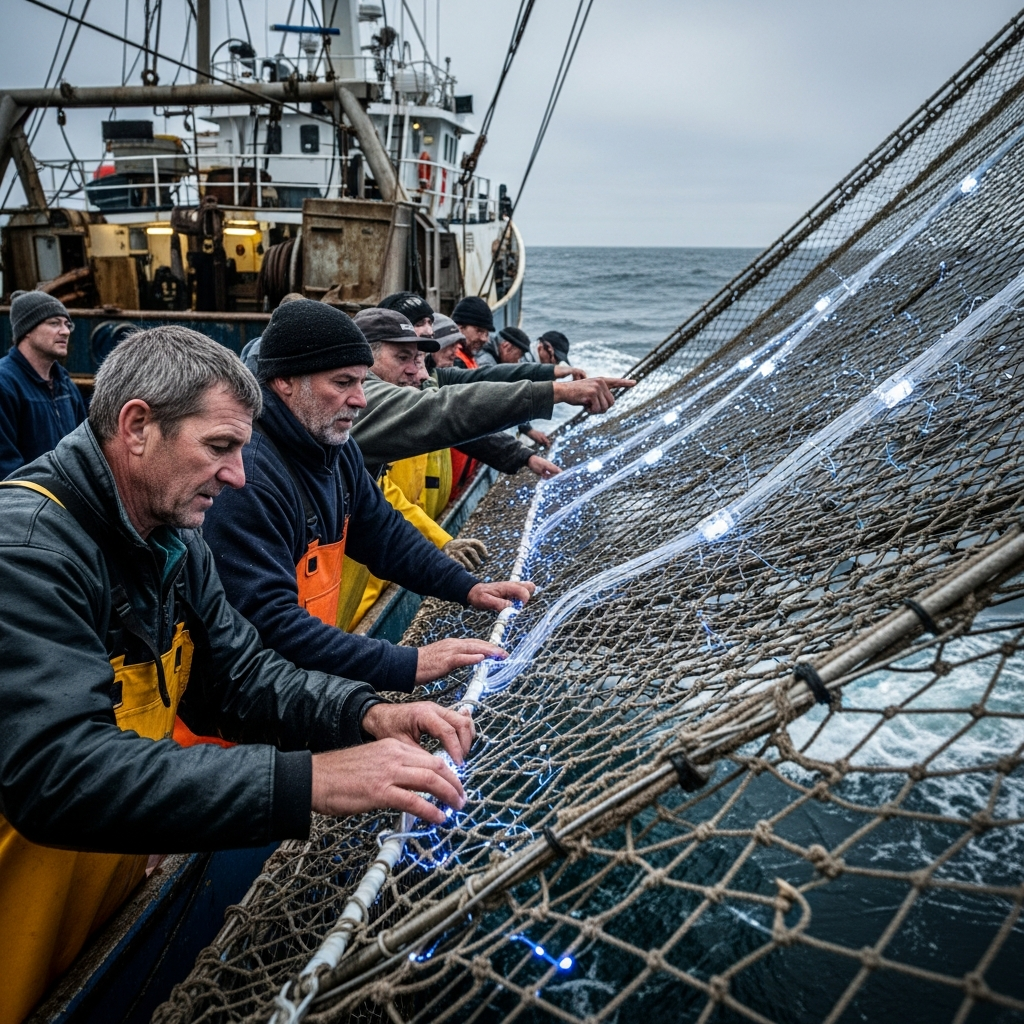
The vanguard of this marine revolution doesn’t rely on heavy machinery, but rather on behavioral science and sensory manipulation. Engineers have discovered that different marine species react to specific sensory inputs in wildly different ways. Enter the illuminated net.
Researchers have begun outfitting trawling nets with highly specialized, battery-powered LED lights. Sea turtles, it turns out, are highly responsive to specific wavelengths of ultraviolet and green light. When these lights are affixed to the escape panels of a net, turtles are visually guided out of the danger zone, while target species like halibut or cod—which are oblivious to those specific light frequencies—remain securely inside. Early implementations of this simple, low-cost hardware upgrade have reduced sea turtle bycatch by a staggering 70 percent in targeted testing grounds.
Similarly, acoustic deterrent devices, or “pingers,” are being engineered to emit high-frequency sound waves that are intensely irritating to cetaceans like dolphins and porpoises, yet completely imperceptible to commercial fish. By creating a localized acoustic forcefield around the net, these devices prevent marine mammals from ever approaching the hazardous webbing.
Hydrodynamic Architecture and AI Integration
Beyond sensory tech, the physical architecture of the nets is undergoing a radical redesign. Modern smart nets utilize advanced hydrodynamic sorting grids—rigid, precisely spaced panels built into the funnel of the net. These grids act as physical algorithms, utilizing the natural water flow to push large bycatch like sharks and turtles up and out through a designated escape hatch, while smaller target fish pass smoothly through the bars into the holding end.
The next frontier, however, is artificial intelligence. Silicon Valley startups are currently testing underwater camera systems equipped with computer vision and machine learning algorithms. Mounted directly onto the trawling gear, these cameras identify the species entering the net in real-time. If the AI detects an unacceptable ratio of bycatch, it instantly alerts the captain in the wheelhouse, allowing them to adjust their depth, alter their speed, or remotely trigger mechanical escape hatches before the ecological damage is done.
The Data-Driven Economics of Sustainable Catch
The brilliance of smart net technology lies in its economic viability. Conservation efforts historically struggle when they pit ecological health against corporate profit. But precision fishing technology aligns the two perfectly.
By drastically reducing bycatch, commercial vessels are experiencing shorter sorting times, lower fuel consumption due to lighter drag, and higher overall quality of their target catch—since target fish are no longer crushed under the weight of massive, unintended marine animals. It is a rare, flawless intersection where doing the right thing for the planet also maximizes the bottom line.
As climate change and overfishing continue to strain our oceans, the margin for error beneath the waves is rapidly shrinking. The era of blind, brute-force trawling is over. The future of the ocean relies on precision, data, and intelligent design—and these revolutionary smart nets are proving that technology can be the ultimate lifeline for our most vulnerable marine ecosystems.
Original Reporting: arstechnica.com