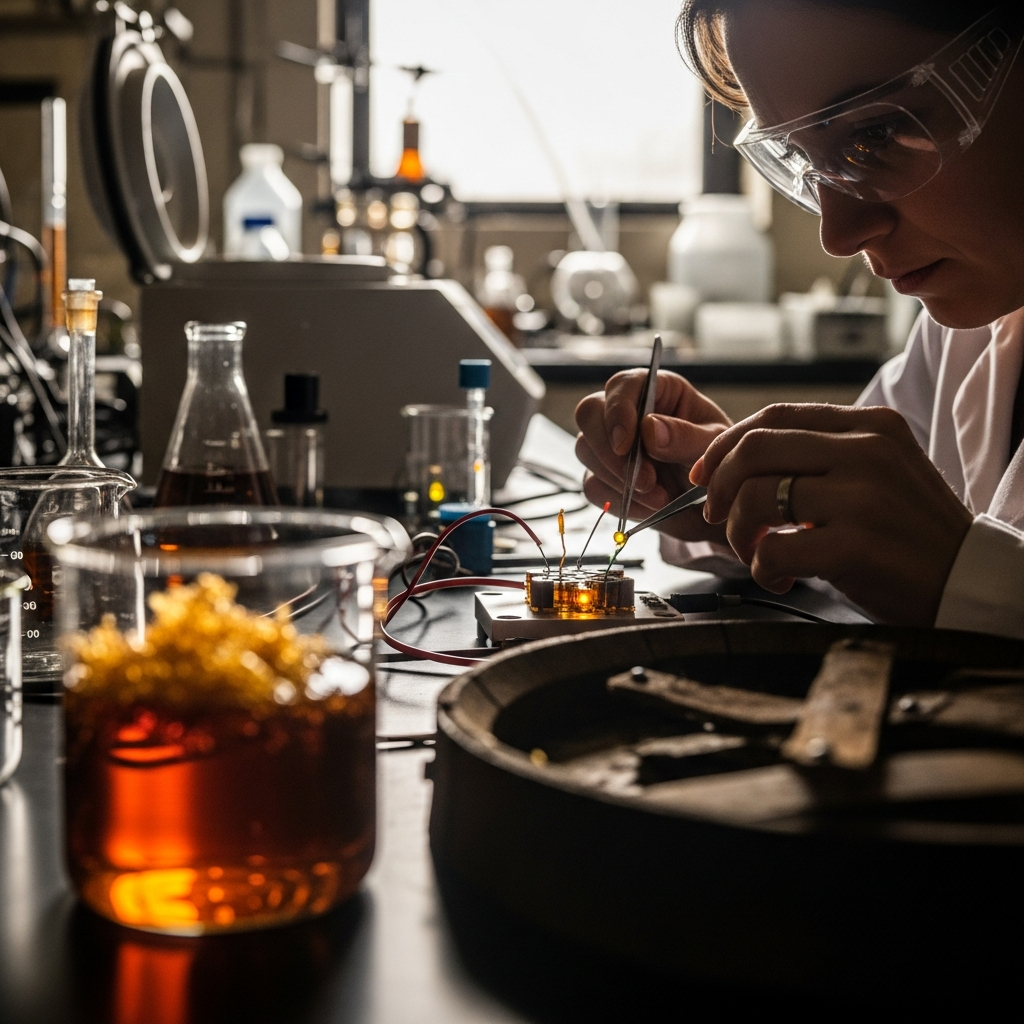
The creation of a premium bourbon is an exercise in meticulous refinement. Master distillers obsess over the mash bill, the char of the oak barrel, and the precise aging climate to produce that perfect amber pour. But behind the romance of Kentucky’s finest export lies an unglamorous, high-volume industrial reality: for every gallon of bourbon produced, roughly ten gallons of highly acidic, sloppy waste are left behind.
Historically, this byproduct—known as stillage—has been the ultimate distillery headache. It is wet, heavy, and environmentally taxing to dispose of, often relegated to low-margin animal feed. But a quiet revolution is brewing in the laboratories of materials scientists, and it has nothing to do with perfecting the ultimate Old Fashioned.
Chemists have discovered a method to upcycle this sloppy bourbon waste into high-grade activated carbon, the critical component required to manufacture next-generation supercapacitors. It is a brilliant collision of the heritage spirits industry and cutting-edge green tech, proving that the future of renewable energy storage might just be hiding at the bottom of a whiskey barrel.
The Stillage Bottleneck
To understand the magnitude of this breakthrough, you have to look at the sheer scale of the waste. The global whiskey market is booming, but the distillation process remains remarkably inefficient in terms of mass retention. Once the alcohol is stripped away from the fermented grain mash, what remains is a thick, nutrient-dense sludge.
Dumping stillage into local waterways is an ecological non-starter; its high biological oxygen demand would devastate aquatic ecosystems. While drying it out for livestock feed is the standard pivot, the energy required to evaporate the water often eclipses the profit margin of the feed itself. The tech world, however, looks at this carbon-rich organic soup not as a liability, but as an untapped raw material.
The Alchemy of Hydrothermal Carbonization
The magic bullet bridging the gap between distillery waste and high-tech electronics is a process called hydrothermal carbonization (HTC). Rather than expending massive amounts of energy attempting to dry the sloppy stillage, HTC uses the water to its advantage.
By placing the wet waste into a specialized reactor and subjecting it to intense heat and pressure—essentially a high-tech industrial pressure cooker—chemists can replicate the natural geological process of coal formation in a matter of hours. The result? The sloppy organic matter is directly converted into hard carbon or highly porous activated carbon.
This is where the tech implications become staggering. Modern electronics are heavily reliant on highly engineered carbon materials. By bypassing the need to mine raw materials or synthesize carbon from petroleum derivatives, HTC offers a closed-loop, environmentally sound method of generating battery-grade carbon directly from agricultural waste.
Powering the Supercapacitor Revolution
While lithium-ion batteries get the lion’s share of media attention, supercapacitors are the unsung heroes of the energy transition. If a traditional battery is a marathon runner, steadily releasing energy over a long period, a supercapacitor is a sprinter. They charge in seconds and deliver massive, instantaneous bursts of power. They are the driving force behind regenerative braking in electric vehicles, rapid-charge public transit systems, and power grid stabilization.
The performance of a supercapacitor is entirely dependent on the surface area of its internal electrodes. The greater the surface area, the more electrostatic charge the device can hold. The activated carbon derived from bourbon stillage via HTC is a microscopic marvel. It is incredibly porous, riddled with nanoscale craters and channels that provide a massive surface area for ion storage.
Early testing indicates that bourbon-derived carbon performs exceptionally well, rivaling or even outperforming commercial carbons currently dominating the market. We are looking at a scenario where a waste product with a negative economic value is transformed into a high-performance material vital to the global transition toward electrification.
A Blueprint for Circular Tech
The tech industry is currently facing a massive supply chain reckoning. As our reliance on portable power and electric vehicles scales exponentially, the scramble for raw materials has exposed deep vulnerabilities in global manufacturing. We can no longer rely solely on finite, heavily mined resources to power the future.
The bourbon-to-supercapacitor pipeline is more than just a clever laboratory trick; it is a scalable blueprint for the circular economy. It solves a massive logistical problem for a multi-billion-dollar beverage industry while simultaneously providing a sustainable, domestic source of high-grade carbon for the electronics sector.
Innovation rarely happens in a vacuum. Often, it requires looking at a centuries-old process and asking how its remnants can serve the future. So, the next time you pour a glass of top-shelf bourbon, take a moment to appreciate the sludge left behind. It might just be the very material powering the device you are reading this on tomorrow.
Original Reporting: arstechnica.com