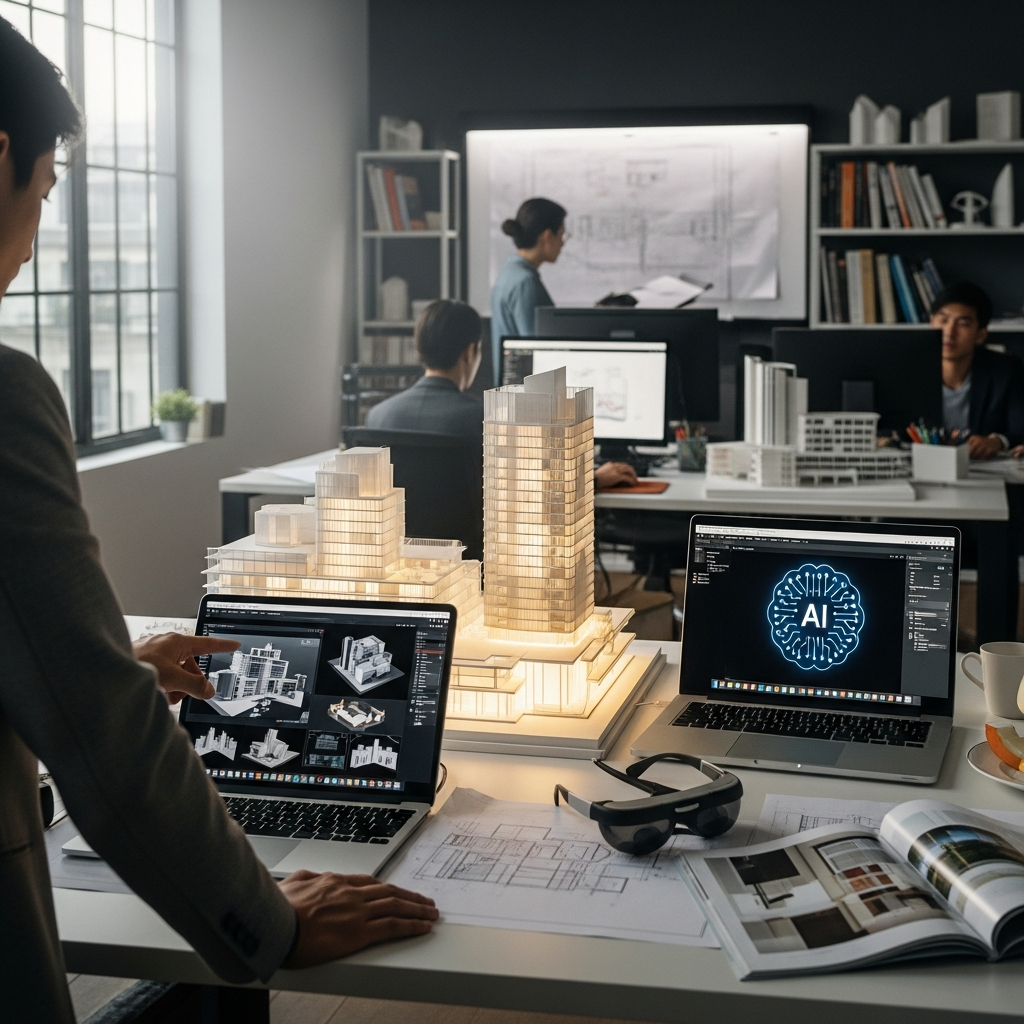
The architectural landscape of 2026 operates on a compressed timeline. The experimental phase of artificial intelligence—characterized by the surreal, often structurally impossible generative imagery of the early 2020s—has officially ended. Today, AI is an operational imperative. For elite firms, machine learning algorithms are no longer novelties; they are foundational infrastructure, driving everything from initial site analysis to final construction documentation.
As the Lead Tech Editor at Plumeo, I have observed a distinct divergence in the market: firms that have integrated AI into their core operations are scaling with unprecedented agility, while those clinging to legacy workflows face shrinking margins and client attrition.
This definitive pillar guide categorizes the premier AI tools defining the architectural practice in 2026. Whether you are optimizing a boutique studio or directing technology for a global conglomerate, these are the platforms required to maintain a competitive edge.
Generative Design & Ideation: The Creation Phase
The initial stages of conceptualization have been entirely rewired. The blank page has been replaced by the intelligent prompt, allowing principals to iterate through hundreds of massing options and aesthetic directions in the time it previously took to draft a single sketch.
LookX: Spatially Aware Conceptualization
While generalist image generators remain useful for mood boards, LookX has emerged as the definitive tool for architectural ideation. Trained specifically on architectural datasets, LookX understands spatial constraints, material properties, and structural logic. In 2026, architects utilize LookX to generate highly specific typologies—such as a mass-timber mid-rise in a high-density urban context—yielding results that are not merely evocative, but geometrically plausible and ready for preliminary client review.
Maket.ai: Automated Floor Plan Generation
For residential and commercial interior planning, Maket.ai has redefined spatial programming. By inputting lot dimensions, zoning restrictions, and client programmatic requirements, Maket instantly generates dozens of optimized floor plan permutations. The true value lies in its constraint-solving algorithms, which ensure that every generated layout adheres to baseline ergonomic and spatial standards, allowing architects to bypass the tedious trial-and-error of initial space planning.
Drafting, Modeling & BIM: The Workflow Phase
The most significant financial drain on any architectural firm is the production of construction documents (CDs). The 2026 suite of workflow AI targets this exact bottleneck, transforming Building Information Modeling (BIM) from a manual drafting exercise into an automated, data-driven process.
Swapp: The End of Manual Construction Documents
Swapp has positioned itself as the preeminent AI-driven BIM manager. By analyzing a firm’s historical Revit files and established detailing standards, Swapp’s algorithms can autonomously generate up to 80% of a standard CD set. This includes automated dimensioning, tagging, and the generation of interior elevations. The result is a drastic reduction in operational overhead, allowing senior technical staff to focus on complex detailing and quality control rather than repetitive drafting.
TestFit: Real-Estate Feasibility and Site Planning
Time kills deals in real estate development. TestFit addresses this by providing instant site feasibility studies. Architects and developers use TestFit to generate rapid massing models that automatically calculate yield, parking ratios, and unit mixes based on local zoning codes. In 2026, the software’s integration with live economic data allows architects to present clients with designs that are immediately validated by financial viability metrics, elevating the architect from a mere designer to a strategic development partner.
Performance, Sustainability & ESG: The Analytics Phase
With global carbon mandates tightening and clients demanding rigorous Environmental, Social, and Governance (ESG) reporting, sustainable design can no longer rely on intuition. Predictive analytics tools are now seamlessly integrated into the early design phases to guarantee performance.
Cove.tool: Real-Time Carbon and Energy Optimization
Cove.tool remains the industry standard for automated building performance analysis. As the architect manipulates a model in Revit or Rhino, Cove.tool’s AI provides real-time feedback on embodied carbon, Energy Use Intensity (EUI), and daylighting metrics. The platform utilizes machine learning to suggest optimal material substitutions and HVAC configurations, ensuring that a building meets LEED or passive house standards long before the engineering consultants are formally engaged.
Spacemaker (Autodesk Forma): Microclimate and Urban Analytics
Now fully matured within the Autodesk ecosystem, Forma utilizes predictive AI to simulate how a proposed building will interact with its environment. It rapidly analyzes wind patterns, acoustic deflection from nearby highways, and solar heat gain. For large-scale urban interventions, this tool is indispensable. It allows firms to objectively prove to city councils and stakeholders that a proposed structure will improve, rather than degrade, the local microclimate.
Client Presentation & Visualization: The Rendering Phase
The days of outsourcing renderings to third-party studios and waiting weeks for a revision are over. AI-augmented rendering engines now operate in real-time, matching the speed of the architect’s thought process.
Veras: AI-Powered Real-Time Visualization
Veras operates as an intuitive plugin for Revit, SketchUp, and Rhino, utilizing text prompts to instantly render raw geometry. During a live client meeting, an architect can toggle a facade from “brushed concrete on an overcast afternoon” to “warm terracotta at golden hour” in seconds. This immediacy fosters a collaborative, dynamic relationship with the client, accelerating the approval process and reducing the friction of aesthetic misunderstandings.
D5 Render: Cinematic Fidelity with Machine Learning
For final, high-end presentations, D5 Render leverages AI for deep learning super-sampling (DLSS) and automated material generation. By utilizing AI to calculate complex global illumination and ray-tracing in real time, D5 allows firms to produce cinematic-quality fly-throughs without the need for massive, on-premise render farms. The software intelligently populates scenes with context-appropriate entourage—adjusting lighting and reflections dynamically—resulting in hyper-realistic visualizations that command premium fees.
The Architecture of Tomorrow
The integration of artificial intelligence into architectural practice is not a narrative of human replacement; it is a narrative of elevation. The tools defining 2026 strip away the rote, mechanical tasks that have historically bogged down the profession. By automating drafting, accelerating feasibility studies, and democratizing complex environmental analytics, AI allows architects to return to their core mandate: synthesizing culture, environment, and human experience into profound built environments.
For the modern firm, the mandate is clear. The adoption of these technologies is no longer a forward-looking strategy—it is the baseline requirement for participation in the highest echelons of global design.