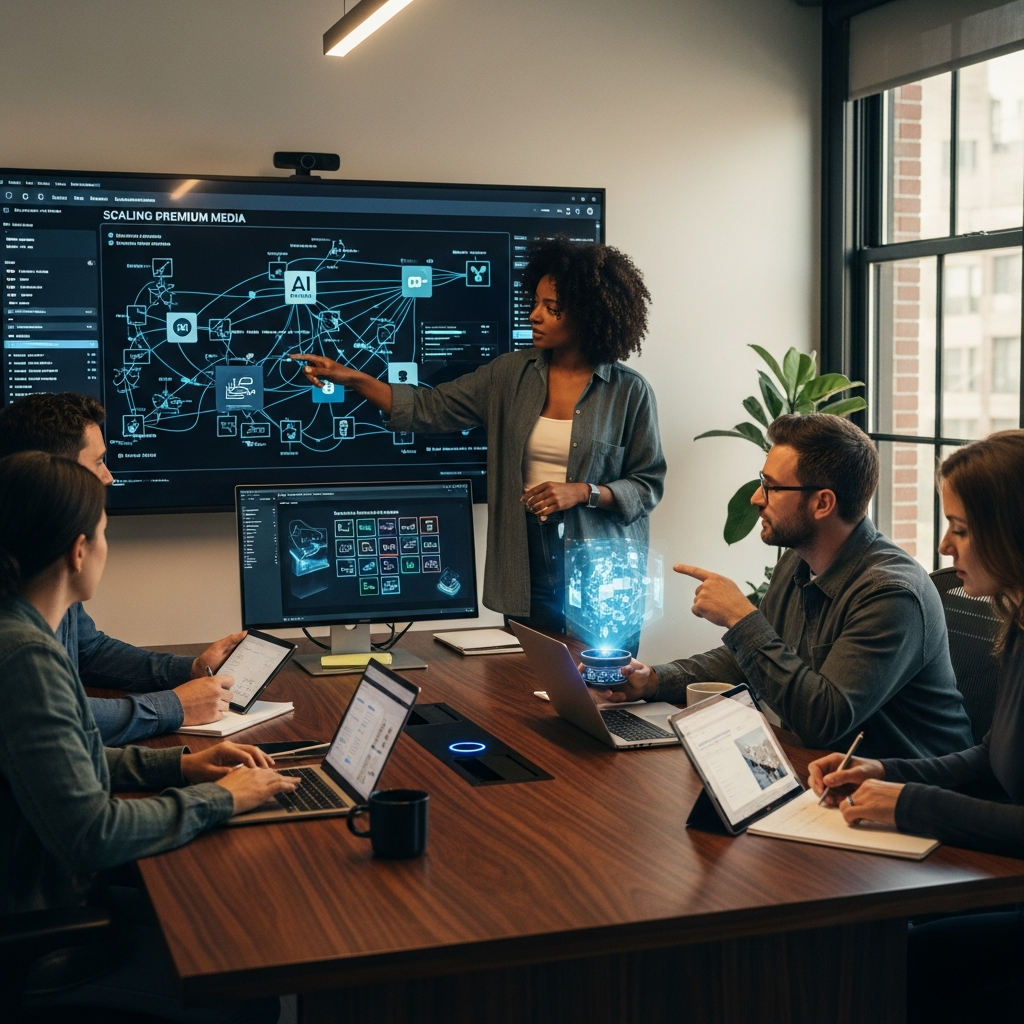
The experimental era of artificial intelligence in media is officially over. We have moved past the novelty of generative party tricks and entered the era of operational integration. For premium publishers, independent creators, and enterprise media brands, AI is no longer a peripheral accessory—it is the foundational infrastructure required to scale high-fidelity content without diluting editorial standards.
As the Lead Tech Editor here at Plumeo, I spend my days analyzing the intersection of technology and premium media. The landscape in 2026 demands a shift in perspective. The most successful creators are no longer treating AI as a replacement for human ingenuity, but as a cognitive exoskeleton. By offloading mechanical execution to algorithmic systems, creators are reclaiming their most valuable asset: strategic bandwidth.
This pillar guide deconstructs the definitive AI tech stack for content creators in 2026. We will examine the enterprise-grade tools dictating the future of generative creation, workflow orchestration, and predictive analytics.
Category 1: Generative Creation and Ideation
The most profound shift in the 2026 creative ecosystem is the maturation of generative models. We have graduated from generic, hallucination-prone outputs to highly specialized, context-aware engines that adapt to a brand’s specific voice, aesthetic, and ethical guidelines.
Advanced Text Generation & Editorial Co-Pilots
The paradigm of prompting a generalized Large Language Model (LLM) and copy-pasting the result is obsolete. Today’s premier text engines function as bespoke editorial co-pilots. Platforms like Claude 4.5 Enterprise and Jasper’s Custom Brand Voice architecture allow creators to train models directly on their proprietary archives.
These tools do not merely write; they synthesize. They can ingest a 45-minute raw interview transcript, extract the most compelling narrative arcs, and draft a long-form feature that meticulously adheres to a publication’s house style. The competitive advantage now lies in “context windows”—the ability of these tools to hold hundreds of thousands of words in memory, ensuring that a serialized newsletter maintains absolute continuity over a six-month campaign.
High-Fidelity Visual & Video Synthesis
Visual AI has crossed the uncanny valley and entered broadcast-ready territory. Tools like Runway Gen-4 and OpenAI’s Sora Pro have transformed video production economics. What previously required a five-person location shoot and a substantial capital allocation can now be generated through precise natural language directives.
For still imagery, Midjourney V8 and Adobe Firefly Enterprise have introduced hyper-granular control mechanisms. Creators are no longer rolling the dice with prompts; they are utilizing localized in-painting, precise lighting adjustments, and consistent character rendering to build cohesive visual identities across multi-platform campaigns. Crucially, these platforms now embed cryptographic “Content Credentials” at the point of creation, satisfying the growing consumer demand for transparent media provenance.
Hyper-Personalized Audio & Voice Cloning
The podcasting and audio-first media sectors have been entirely rewired by synthetic acoustics. ElevenLabs and Descript’s Overdub technology now capture not just the timber of a creator’s voice, but the micro-expressions, pacing, and emotional resonance.
In 2026, premium creators are utilizing these tools for seamless localization. A flagship podcast recorded in English can be autonomously translated, synthesized, and distributed in Mandarin, Spanish, and Arabic—using the host’s exact vocal signature—within minutes of the final edit. This enables an unprecedented global reach for independent media properties.
Category 2: Workflow Automation & Production Orchestration
While generative tools command the headlines, the highest return on investment (ROI) is found in workflow automation. The friction of media production—scheduling, cutting, formatting, and file management—has been aggressively optimized by intelligent orchestration platforms.
Autonomous Editorial Calendars
Strategic planning is no longer a manual exercise relying on intuition. AI-driven operating systems like Notion AI and Airtable’s Copilot ingest market trends, competitor output, and historical performance data to construct predictive editorial calendars.
These systems identify content gaps in the market before they are fully realized by competitors. They autonomously assign briefs, set deadlines based on individual creator velocity, and adjust publishing schedules in real-time to capitalize on emerging algorithmic trends across social ecosystems.
Algorithmic Post-Production & Editing Engines
The editing bay has undergone a radical transformation. Post-production platforms now leverage machine learning to automate the most labor-intensive aspects of video and audio editing. Tools like Autopod and Premiere Pro’s AI suite can instantly execute multi-cam cuts based on active speaker recognition, strip out background noise, and apply broadcast-standard color grading.
More impressively, these engines now edit for retention. By analyzing historical audience drop-off data, AI editors can autonomously trim silences, insert b-roll, and pace a video specifically designed to maximize completion rates on platforms like YouTube and TikTok.
Category 3: Predictive Analytics & Audience Intelligence
Publishing content into a void and hoping for traction is a relic of the past. The 2026 creator relies on predictive analytics to ensure that every piece of media finds its precise target demographic.
Real-Time Sentiment & Engagement Tracking
Modern analytics bypass vanity metrics (likes and views) in favor of deep sentiment analysis. Platforms like Sprout Social’s AI tier and Brandwatch utilize natural language processing to read the emotional temperature of audience comments and shares.
Creators can now measure “resonance.” If a high-end video essay on architectural design is published, the AI tracks whether the audience is expressing inspiration, confusion, or debate, allowing the creator to adjust the angle of their follow-up content instantaneously.
Algorithmic SEO & Dynamic Distribution
Search Engine Optimization has evolved to meet the demands of AI-generated search experiences (like Google’s SGE). Static keyword stuffing has been replaced by semantic authority. AI SEO tools like Surfer AI and Clearscope analyze the entire web’s conversational landscape to ensure a piece of content answers the exact questions audiences are asking conversational agents.
Furthermore, dynamic distribution engines take a single core piece of content—say, a 5,000-word Plumeo pillar post—and autonomously fracture it into native formats for LinkedIn, X, Instagram Reels, and email newsletters, optimizing the hook and format for the specific algorithmic constraints of each platform.
The Authenticity Mandate: The Human Premium in an AI World
As AI tools commoditize the mechanics of content production, the value of the output itself shifts. When anyone can generate a 1,000-word article or a 60-second cinematic video instantly, the premium is no longer on the *ability to create*, but on the *perspective behind the creation*.
At Plumeo, we call this the “Human Premium.” The AI tools of 2026 are highly advanced engines, but they still require a driver with taste, lived experience, and a distinct point of view. The creators who will dominate the next decade are those who use AI to handle the scale, the formatting, and the distribution, while fiercely protecting the human element—the original thought, the contrarian opinion, and the authentic connection—that algorithms cannot replicate.
Mastering this tech stack is not about replacing your creative spirit; it is about amplifying it to a global scale. Implement these systems thoughtfully, optimize your workflows ruthlessly, and let the technology handle the noise so your voice can finally cut through.