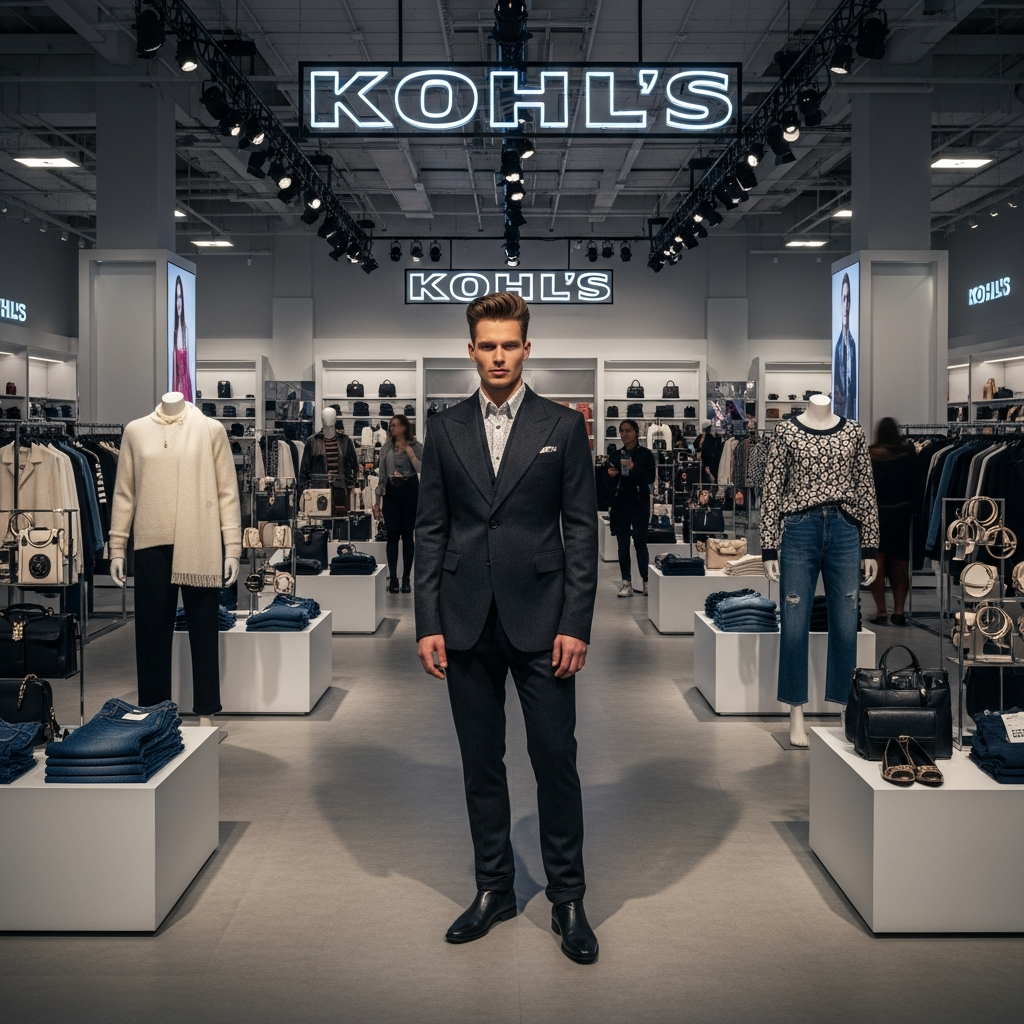
Before the red carpets, the breathless magazine profiles, and the cultural phenomenon that is Love Story, Paul Anthony Kelly was mastering a decidedly different kind of camera angle: the accessible, fiercely commercial e-commerce product shot. In a digital excavation that has sent both social media and retail analytics into overdrive, fans of the breakout actor have unearthed his past life as an e-commerce model for Kohl’s. Rather than fading into the digital ether as a piece of trivial internet lore, this discovery has ignited a massive consumer movement, transforming mid-tier department store staples into the season’s most coveted menswear.
The contemporary consumer craves proximity to their idols. Historically, this proximity has been gatekept by luxury European heritage houses, which sign newly minted A-listers to multi-million-dollar ambassador contracts to peddle four-figure handbags and bespoke tailoring. The Paul Anthony Kelly revelation, however, has flipped the traditional celebrity endorsement model on its head. It has introduced an entirely new retail phenomenon: the hyper-accessible, accidental campaign.
The Anatomy of an Accidental Campaign
When internet sleuths first uncovered images of Kelly sporting Kohl’s in-house menswear brands, the reaction was swift and multifaceted. For the fandom, it was an endearing glimpse into the actor’s humble beginnings—the classic Hollywood narrative of the struggling artist paying his dues. For the fashion industry, it was a fascinating case study in consumer psychology. Fans didn’t just share the images; they immediately sought out the garments.
The appeal lies in the democratization of the “boyfriend aesthetic.” Unlike a $3,000 runway coat that fans can only admire from afar, a $45 cable-knit sweater or a $30 flannel shirt modeled by the internet’s reigning leading man is an immediate, frictionless purchase. It allows the consumer to buy into the fantasy of the actor’s persona without the barrier of luxury pricing. This sudden surge in demand proves that modern influence is less about the prestige of the label and entirely about the cultural resonance of the person wearing it.
Agile Marketing in the Age of Fandom
The true brilliance of this viral moment belongs not just to the enthusiastic fan base, but to the corporate agility demonstrated by Kohl’s. In an era where legacy retailers often struggle to capture the cultural zeitgeist, Kohl’s executed a masterclass in reactive marketing. Rather than ignoring the chatter or issuing a sterile corporate acknowledgment, the department store leaned entirely into the narrative.
By actively re-surfacing the archival photos of Kelly modeling their in-house lines, Kohl’s legitimized the fan frenzy. They recognized that they were sitting on a goldmine of earned media. By repositioning these basic e-commerce shots as culturally relevant fashion editorials, Kohl’s seamlessly converted viral social media impressions into tangible, high-volume e-commerce conversions. They effectively transformed a routine catalog shoot from years past into the most engaging, high-ROI marketing campaign of their current fiscal quarter.
Redefining the Value of Earned Media
From a purely business perspective, the financial implications of the “Paul Anthony Kelly Effect” are staggering. Traditional fashion marketing relies on carefully orchestrated rollouts, massive media buys, and calculated influencer seeding. Kohl’s, conversely, is currently reaping the benefits of organic, user-generated momentum. The brand has achieved a level of cultural saturation that money simply cannot buy, tapping into a younger, highly engaged demographic that might have previously overlooked the retailer in favor of fast-fashion giants or direct-to-consumer disruptors.
This phenomenon serves as a critical wake-up call for retail executives across the spectrum. The modern consumer landscape is dictated by organic discovery and the rapid mobilization of online communities. Brands that maintain the operational agility to pivot and capitalize on these unpredictable cultural moments will invariably outpace those tethered to rigid, traditional marketing calendars.
The Future of Celebrity-Driven Retail
As fans continue to clear out Kohl’s digital inventory, snapping up the exact cardigans and chinos once modeled by the Love Story star, the broader fashion industry is taking frantic notes. The line between high culture Hollywood stardom and accessible, everyday retail has never been thinner.
Paul Anthony Kelly’s unintentional tenure as a menswear influencer highlights a shifting paradigm. Today’s ultimate status symbol isn’t necessarily the most expensive item in the room; it is the item imbued with the most potent cultural narrative. Through a combination of internet sleuthing, undeniable star power, and razor-sharp corporate reflexes, a mid-western department store has momentarily become the epicenter of global fashion commerce. And as the digital registers continue to ring, it is clear that authenticity—even in the form of a vintage e-commerce gig—remains the most lucrative currency in retail.
Inspiration & Original Reporting: wwd.com