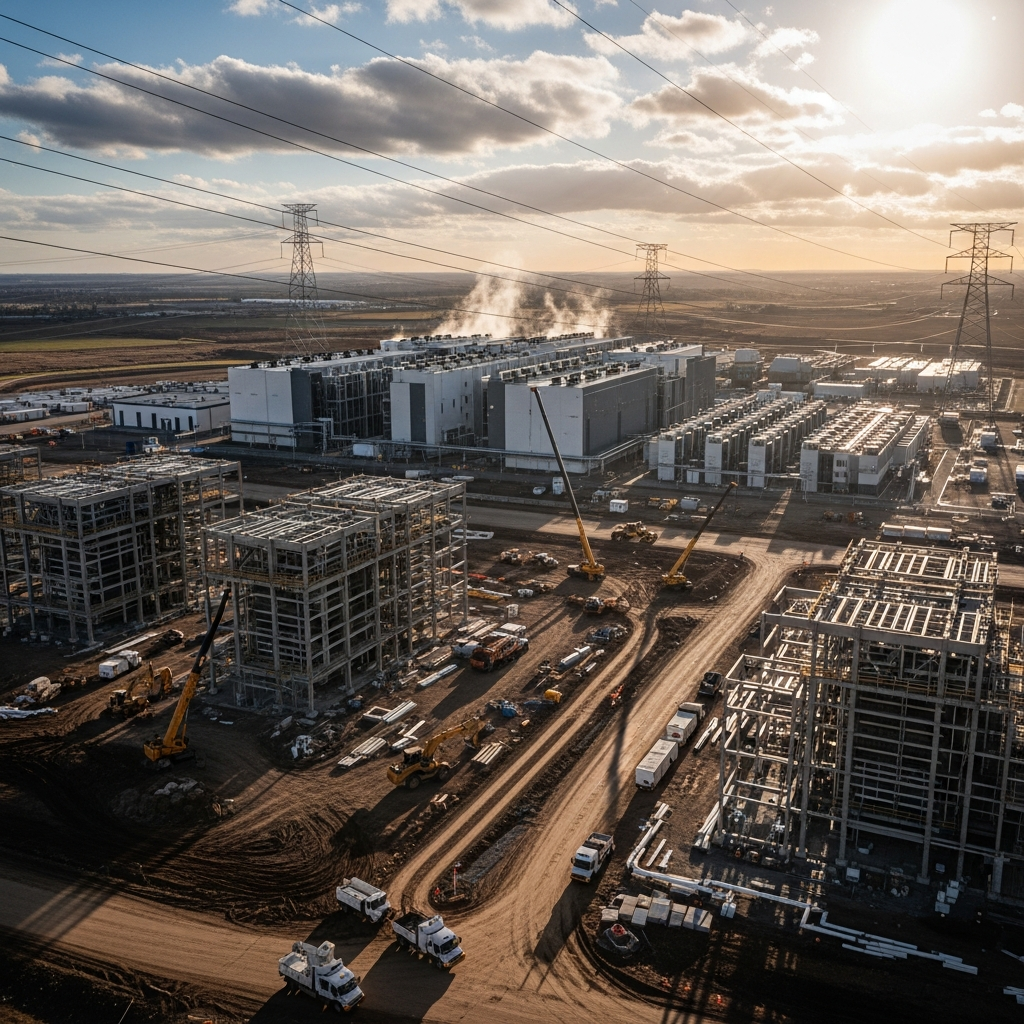
For years, Silicon Valley sold us the “cloud” as an ethereal, weightless utopia. We were conditioned to believe that our digital lives existed in a pristine, eco-friendly vacuum. But the generative artificial intelligence boom has violently shattered that illusion, revealing the cloud for what it truly is: a sprawling, heavy industry with an insatiable appetite for raw electricity.
Nothing illustrates this harsh reality better than Meta’s latest infrastructure pivot. To feed its upcoming Hyperion AI data center, Mark Zuckerberg’s empire is commissioning ten entirely new natural gas plants. Let the sheer scale of that sink in. This single corporate facility will require enough baseline electricity to power the entire state of South Dakota. It is a staggering regression to fossil fuels, and it signals a quiet but profound panic sweeping through the highest echelons of big tech.
The Anatomy of a Megaproject
To understand why a social media conglomerate suddenly needs the energy infrastructure of a small nation, you have to look at the physics of artificial intelligence. Training next-generation large language models (LLMs) is not akin to hosting websites or storing smartphone backups. It is a brute-force mathematical grind.
Meta’s Hyperion project is designed to house hundreds of thousands of advanced GPUs, likely the latest silicon from Nvidia. These chips run hot and demand continuous, unyielding wattage. Unlike standard servers, AI compute clusters operate at maximum capacity around the clock. They require massive cooling systems to prevent the hardware from melting down. When you scale this architecture to the size of a mega-campus, the electrical demands transcend the capabilities of local power grids.
The Death of the Net-Zero Dream
The tech industry has spent the last decade wrapping itself in the banner of environmental sustainability. Meta, Google, and Microsoft have all made highly publicized pledges to achieve net-zero emissions and run their operations entirely on renewable energy. So, why natural gas?
The uncomfortable truth is that renewable energy simply cannot keep pace with the AI arms race. Solar and wind power are intermittent; they rely on the sun shining and the wind blowing. AI data centers cannot afford a drop in voltage when the weather changes. They require absolute, 24/7 reliability—what the energy sector calls “baseload power.”
While nuclear energy is often touted as the ultimate clean baseload solution, building a nuclear reactor takes decades of regulatory battles and construction. Meta does not have decades. The AI war is being fought right now. Natural gas, despite its carbon footprint, is the only energy source that can be deployed fast enough, and at a large enough scale, to keep Hyperion online.
The South Dakota Metric
When we talk about energy consumption, the numbers often become so large they lose all meaning. Measuring Meta’s new project against the state of South Dakota grounds the abstraction in a sobering reality. South Dakota is home to over 900,000 people, thousands of businesses, hospitals, schools, and heavy agriculture.
Meta is matching that entire state’s electrical consumption to train algorithms. It is a profound reallocation of global resources. Ten new natural gas plants mean decades of locked-in carbon emissions, effectively erasing years of corporate climate progress in a single stroke. It forces a deeply uncomfortable question: Is the promise of a smarter chatbot or a more hyper-personalized algorithm worth the environmental collateral damage?
The Ripple Effect Across Silicon Valley
Meta is not an outlier; they are just the first to quietly say the quiet part out loud. The entire tech ecosystem is currently slamming into the physical limits of the global power grid. Microsoft is desperately trying to restart dormant nuclear plants, while Google’s emissions have spiked by nearly 50% over the last five years due to AI integration.
The Hyperion project sets a dangerous precedent. If Meta successfully powers its AI ambitions through a massive natural gas binge, competitors will inevitably follow suit to maintain parity. The competitive advantage of superior AI models is currently viewed as an existential imperative by tech CEOs. Climate pledges, it seems, are entirely negotiable when market dominance is on the line.
As we march toward an AI-integrated future, we must strip away the marketing jargon and confront the physical cost of our digital progress. The intelligence of tomorrow is not being powered by the sun or the wind. It is being forged in the fires of combustion.
Original Reporting: techcrunch.com