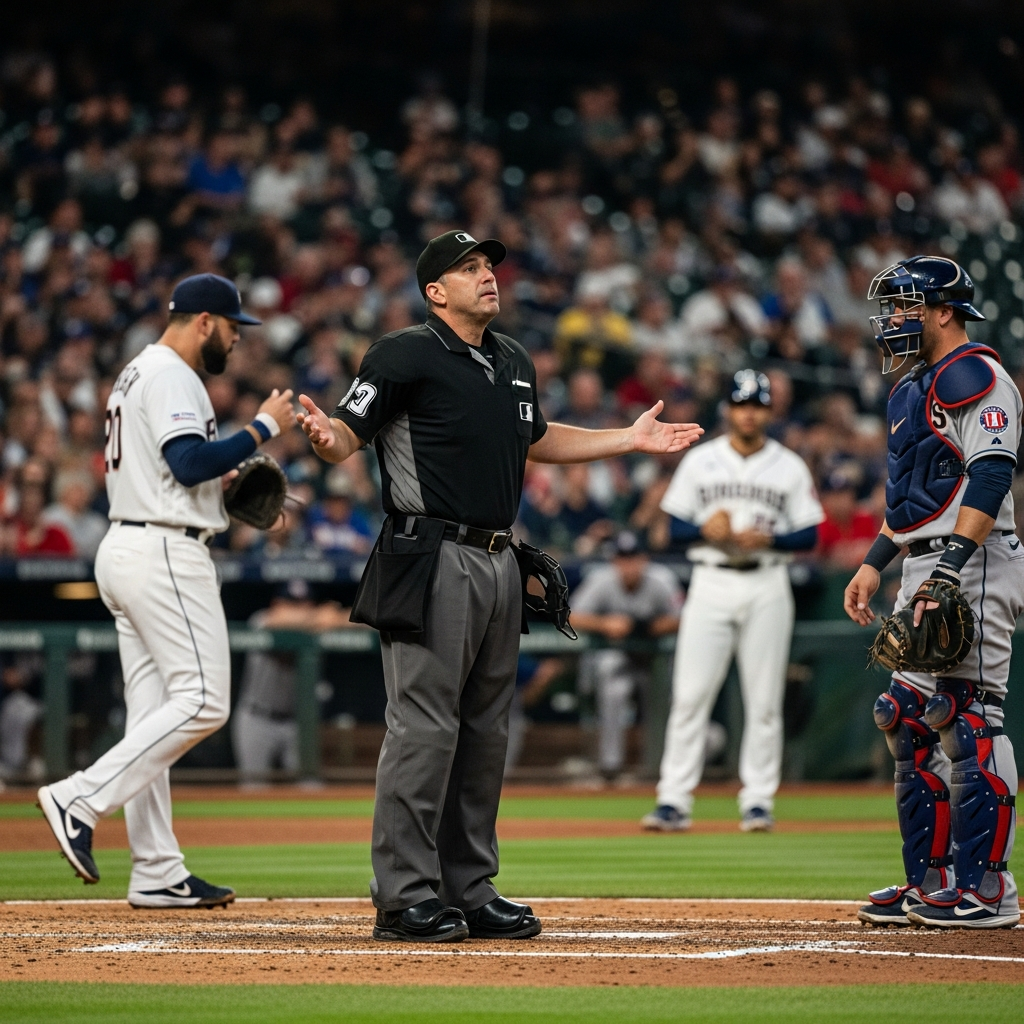
Baseball has long romanticized the “human element.” It is a sport built on the poetry of imperfection—the bad hop, the unpredictable wind, the subjective strike zone. But in the modern era of high-definition broadcasts, ultra-slow-motion replays, and advanced analytics, the threshold for human error has drastically shrunk. This week, veteran umpire C.B. Bucknor found himself standing squarely in the unforgiving glare of this technological crucible, and the results are forcing a conversation Major League Baseball can no longer postpone.
The Tuesday Night Fiasco
During Tuesday night’s interleague clash between the Tampa Bay Rays and the Milwaukee Brewers, the spotlight once again found Bucknor for all the wrong reasons. On a play at first base—a fundamental sequence that serves as the bedrock of diamond officiating—Bucknor missed the call. The dugout immediately signaled for a challenge, the replay room in New York intervened, and the call was swiftly overturned.
In a vacuum, a blown call at first base is a forgivable offense. The modern athlete moves at blistering speeds, and the margin between safe and out is often measured in milliseconds. However, Bucknor does not exist in a vacuum; he currently exists in the crosshairs of a deeply frustrated baseball public. Tuesday’s overturned call was not an isolated incident, but rather the continuation of a troubling, data-backed trend that has plagued the veteran official’s recent performances.
The Empirical Shadow of the ABS
What makes the Rays-Brewers blunder so damning is the context of the preceding weekend. Major League Baseball has been quietly but rigorously evaluating its Automated Ball-Strike (ABS) system—colloquially known as the “robot umpire.” When the data from last weekend’s ABS evaluations was compiled, Bucknor’s metrics didn’t just scrape the bottom of the barrel; they redefined it. He recorded the absolute poorest results among all umpires evaluated by the new system.
The ABS data strips away the polite fictions of the game. It removes the polite deference managers show to veteran officials and replaces it with cold, hard geometry. When an umpire’s strike zone begins to resemble a Rorschach test rather than a standardized rectangle, the charm of the human element evaporates. The abysmal ABS grade behind the plate, coupled immediately with a blown call on the base paths, points to a systemic degradation in processing speed and visual acuity. Bucknor is no longer just having a bad night; he is becoming a statistical liability to the competitive integrity of the sport.
The Unwitting Poster Child for Automation
There is a profound irony in Bucknor’s current predicament. For years, baseball purists have fought tooth and nail against the implementation of automated officiating, arguing that the game would lose its soul if machines made the calls. Yet, through his consistently documented inaccuracies, Bucknor is inadvertently acting as the most compelling advocate for the very technology that threatens to replace him.
Players and managers are reaching a boiling point. In an era where front offices optimize every single pitch, swing, and defensive shift using billions of data points, leaving the ultimate outcome of those optimized plays to arbitrary human guesswork feels like an anachronism. The friction between the precision of the modern athlete and the inaccuracy of the aging official is creating an unsustainable tension on the field. When a manager has to burn a replay challenge on a routine play at first base, it disrupts the flow of the game and undermines the authority of the umpiring crew as a whole.
The Tipping Point for Major League Baseball
Commissioner Rob Manfred and the MLB brass have been methodically testing the waters of automated officiating in the minor leagues, gathering data and waiting for the right moment to introduce it to the Show. They have been cautious, wary of the traditionalist backlash. But the narrative is shifting. The data is no longer just whispering in the background; it is screaming from the jumbotrons.
C.B. Bucknor has had a long, storied career in Major League Baseball, dedicating decades of his life to the sport. But the sport has evolved into a hyper-analyzed, high-stakes enterprise where a single missed call can alter the trajectory of a season. High-speed cameras do not blink. Automated strike zones do not guess. They offer a sterile, uncompromising fairness that the modern game desperately requires.
As the spotlight burns hotter on Bucknor’s recent missteps, it illuminates a much larger truth about the future of baseball. The question is no longer *if* the automated systems will take over the heavy lifting of officiating, but *when*. And if the data from this past week is any indicator, that future cannot arrive soon enough.
Original Reporting: www.espn.com