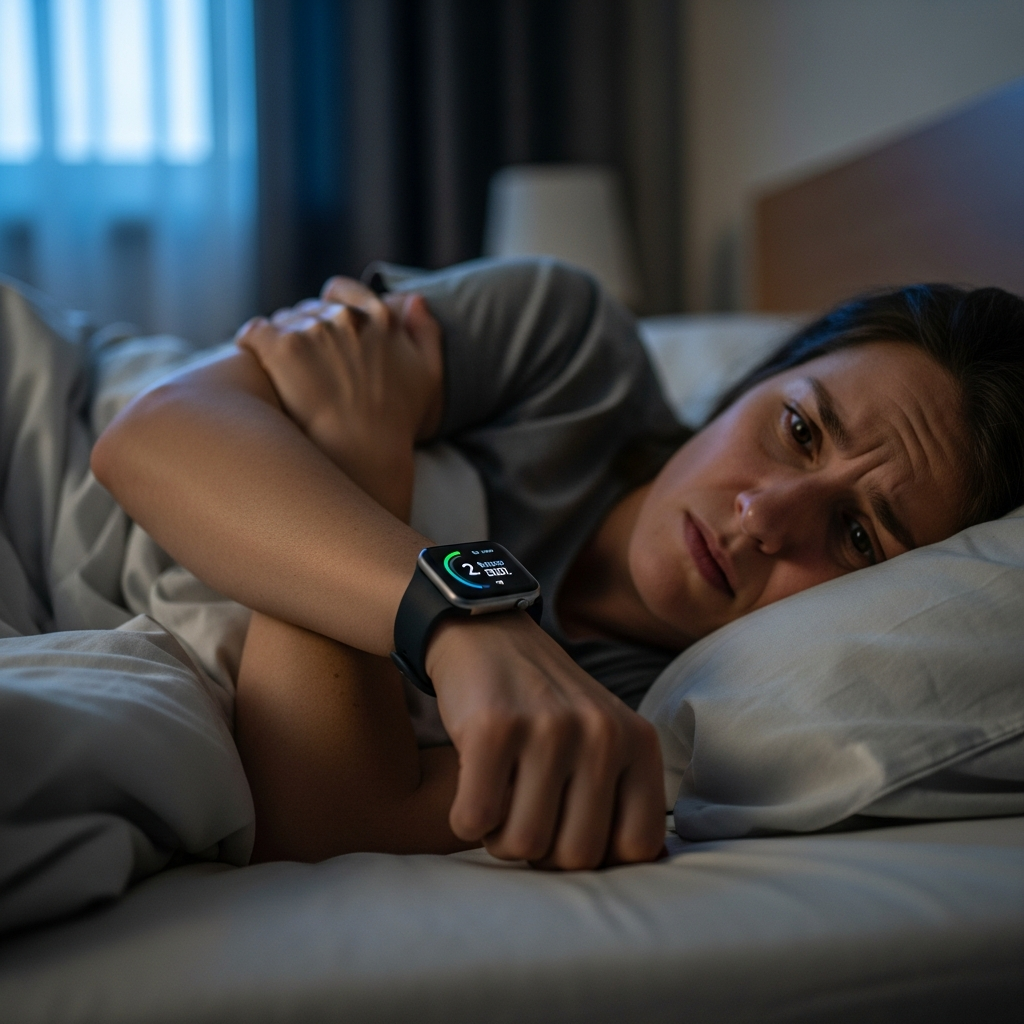
There is a distinct modern irony in waking up from what felt like a spectacular night of rest, only to look at your wrist and be told you are exhausted. We have entered the era of the quantified self, strapping titanium rings to our fingers and algorithmic sensors to our wrists, all in the pursuit of the perfect night’s sleep. Yet, in our desperation to conquer our circadian rhythms, we have forgotten a fundamental biological truth: sleep is a mechanism of surrender, not a metric to be dominated.
The harder you try to control your sleep, the more elusive it becomes. Sleep specialists have even coined a term for this modern affliction—orthosomnia. It is the obsessive pursuit of optimal sleep driven by wearable data, which ironically triggers the exact hyper-arousal and anxiety that prevents deep rest. As the Lead Editor of Plumeo, I have tested every high-end wearable on the market. The technology is breathtaking. But the psychology of how we interact with it is deeply flawed.
If you want to truly optimize your recovery, you do not need to abandon your smart rings or watches. You simply need to learn how to read them—and more importantly, how to ignore them.
How to Extract the Signal from the Algorithmic Noise
Wearables are extraordinary at measuring physiological baselines, but they are notoriously mediocre at staging sleep. Your tracker cannot definitively tell if you are in REM or light sleep just by reading your pulse and wrist movement. It is making an educated, algorithmic guess.
To use a sleep score correctly, you must stop viewing it as a daily report card. Instead, treat your sleep data as a long-term compass. A single night of a “58” or a “Poor” rating is scientifically meaningless in isolation. What matters is the macro-trend. If your deep sleep metrics drop for three consecutive weeks, your wearable is successfully flagging a lifestyle issue—perhaps chronic stress, an uptick in evening alcohol consumption, or a bedroom temperature that is consistently too high.
Look for deviations in your absolute baselines. Your resting heart rate (RHR) and heart rate variability (HRV) are the undeniable truths your wearable captures. If your HRV is plummeting over a seven-day rolling average, your nervous system is screaming for a break. That is when the data is invaluable.
How to Identify the Nocebo Effect
The most dangerous element of a sleep score is its ability to hijack your waking reality. This is known as the nocebo effect—the phenomenon where a negative expectation creates a negative outcome. If your app tells you that your recovery is terrible, you are highly likely to feel sluggish, irritable, and unfocused, regardless of your actual physiological state.
You must audit your emotional reaction to your morning data sync. If seeing a low sleep score dictates your mood, prompts you to cancel a workout, or makes you dread the coming workday, the technology is no longer serving you. You have become subordinate to the algorithm. When the data begins to dictate your physical autonomy, it is time to implement a strategic disconnect.
The Plumeo Protocol: How to Master Intuitive Tracking
Reclaiming your rest requires a hybrid approach. You can leverage the brilliance of Silicon Valley engineering without sacrificing the intuitive wisdom of your own biology. Here is how to restructure your relationship with sleep tech.
First, institute the “Blind Sync” rule. Do not look at your sleep score immediately upon waking. Spend the first hour of your day hydrating, getting sunlight in your eyes, and assessing how your body actually feels. Ask yourself: Am I energized? Is my mind clear? Only after you have established your own subjective baseline should you open the app. This simple act of delayed gratification removes the algorithm’s power to dictate your morning.
Second, stop curating the data and start curating the environment. Wearables are passive observers; they do not put you to sleep. Shift your obsession from the morning score to the evening wind-down. Optimize your bedroom for thermal regulation, eliminate blue light ninety minutes before bed, and establish a cognitive off-ramp. When you perfect the environment, the metrics will naturally follow.
Finally, utilize strategic tech fasts. Choose one week every quarter to take off the watch, remove the ring, and sleep entirely unmonitored. This reminds your nervous system that you are entirely capable of resting without digital supervision.
Data is a mirror, not a master. A sleep score is a brilliant tool for identifying long-term lifestyle friction, but the moment you close your eyes, the metrics cease to matter. True optimization is knowing when to look at the numbers, and when to simply turn off the lights and let biology do what it has done flawlessly for millennia.
Original Reporting: lifehacker.com